| | In this edition: South Africa’s government sues itself, US visa bonds program becomes permanent, and͏ ͏ ͏ ͏ ͏ ͏ |
| |  Pretoria Pretoria | Nairobi | Khartoum |
 | Africa |  |
| |
|
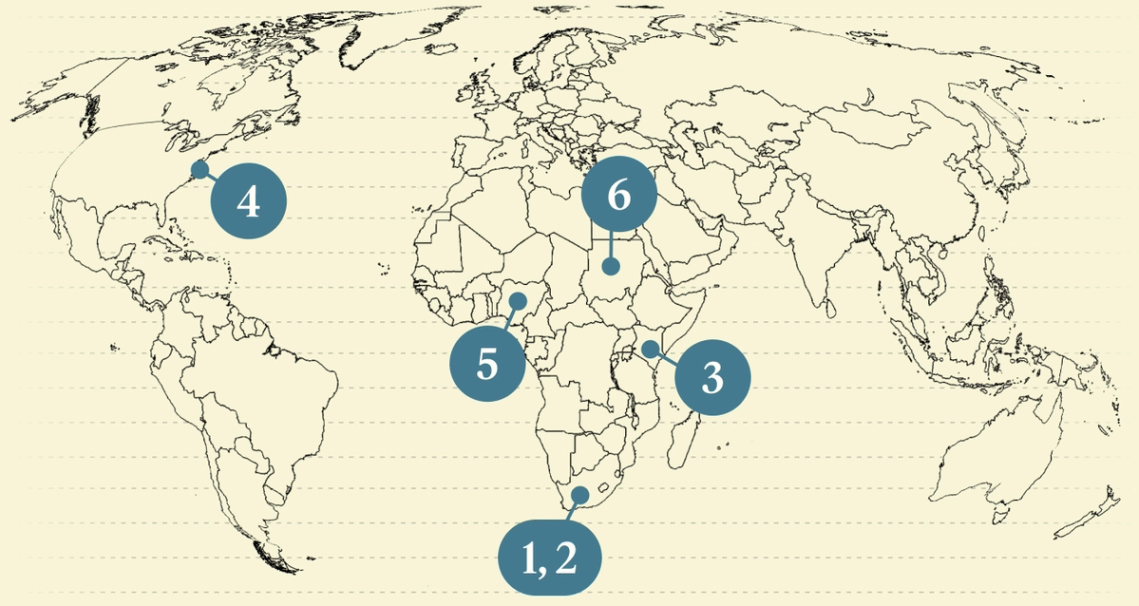 - S. Africa fund CEO ruling
- Pretoria’s land dispute
- Investors favor mature firms
- Visa bonds become permanent
- Military wages raised
- UAE’s $100M gold bonanza
 Tyla drops Lagos from her debut world tour |
|
S. African court reinstates fund CEO |
 Patrick Dlamini. World Economic Forum/Benedikt von Loebell/Flickr. License: CC BY-NC-SA 2.0. Patrick Dlamini. World Economic Forum/Benedikt von Loebell/Flickr. License: CC BY-NC-SA 2.0.A South African court has ordered the reinstatement of the head of Africa’s largest asset manager, overturning a board suspension that triggered weeks of governance chaos at the $200 billion state-owned pension fund. Patrick Dlamini returns to lead the Public Investment Corporation — the lifeblood of South African capital markets, holding roughly 20% of the Johannesburg bourse — alongside a completely overhauled board. The court ruled the previous board acted unlawfully when it suspended Dlamini last month without requiring government approval. That suspension sparked a high-level rift between Finance Minister Enoch Godongwana and the former board chair David Masondo, who is also his deputy minister. It forced Masondo’s exit and the collapse of the board. Godongwana appointed Seiso Mohai, a deputy minister in President Cyril Ramaphosa’s office, alongside new executive directors including former African Development Bank vice president Swazi Tshabalala. Dlamini and the new team take control as the financial sector watchdog continues its independent investigation into the fund’s governance and its $6 billion unlisted portfolio — about 40% of which is distressed. — Tiisetso Motsoeneng |
|
South Africa sues itself over land law |
 Siphiwe Sibeko/Reuters Siphiwe Sibeko/ReutersSouth Africa’s ruling coalition turned on itself in court over a new land reform law at the heart of a diplomatic rift with the US. A lawsuit spearheaded by the Democratic Alliance — the government’s second-largest party, traditionally backed by white South Africans — claims the Expropriation Act is at odds with international investment treaties and was passed through flawed parliamentary procedures. The legal showdown, in which the DA has teamed up with lobbyists, will test the government’s stability. The legislation, signed into law in early 2025, allows the government to seize private land for public use, paying zero money to the owner in certain circumstances, such as abandoned properties. Land ownership remains a charged issue in South Africa more than 30 years after the end of white minority rule. Some 72% of private land is owned by white people, who make up around 7% of the population, according to the latest available land audit by the government. The law drew a swift reaction from Washington: President Donald Trump told federal agencies to consider potential refugee status for white Afrikaner farmers and issued executive orders freezing aid for South Africa. — Tiisetso Motsoeneng |
|
New startups face funding squeeze |
| |  | Alexander Onukwue |
| |
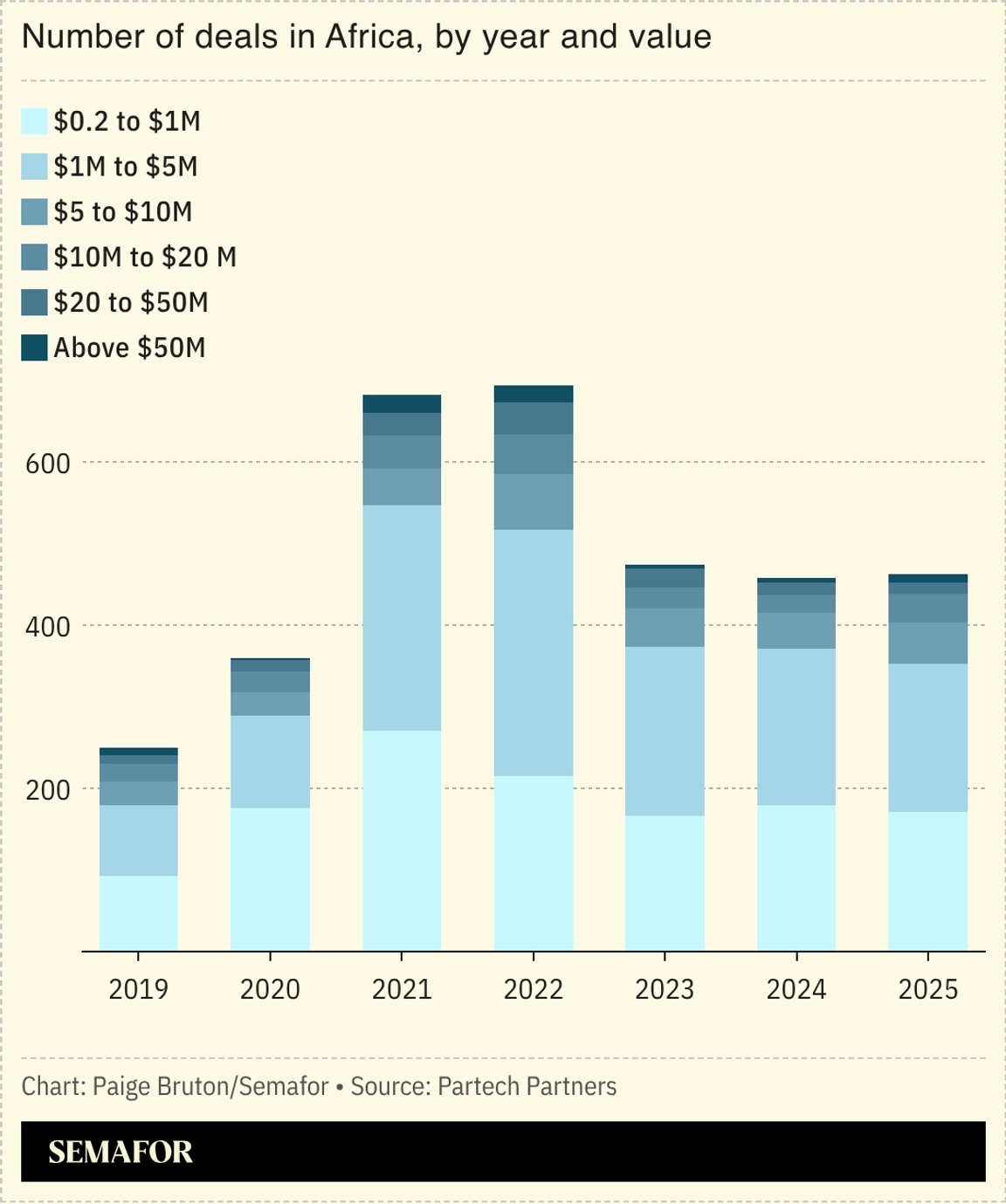 Africa’s early-stage startups are facing a new funding squeeze as venture capital firms increasingly prioritize backing proven companies over riskier young ventures in a bid to deliver returns to investors. In the first half of the year, African startups raised around $1.4 billion, on par with the same period last year. But the number of deals fell sharply, according to separate fundraising tallies by Africa: The Big Deal, and TC Insights, while average check sizes increased. Beneficiaries of this trend tend to be later-stage companies with strong revenues, scale, and a firm handle on customer needs, rather than seed and series A startups that are still formulating their strategy, investors told Semafor. Later-stage startups have always attracted more of the available investor money. But in the years following African tech funding’s peak of 2022, larger startups appear to attract more funding as newer ones raise less. |
|
US makes visa bonds permanent |
| |  | Adrian Elimian |
| |
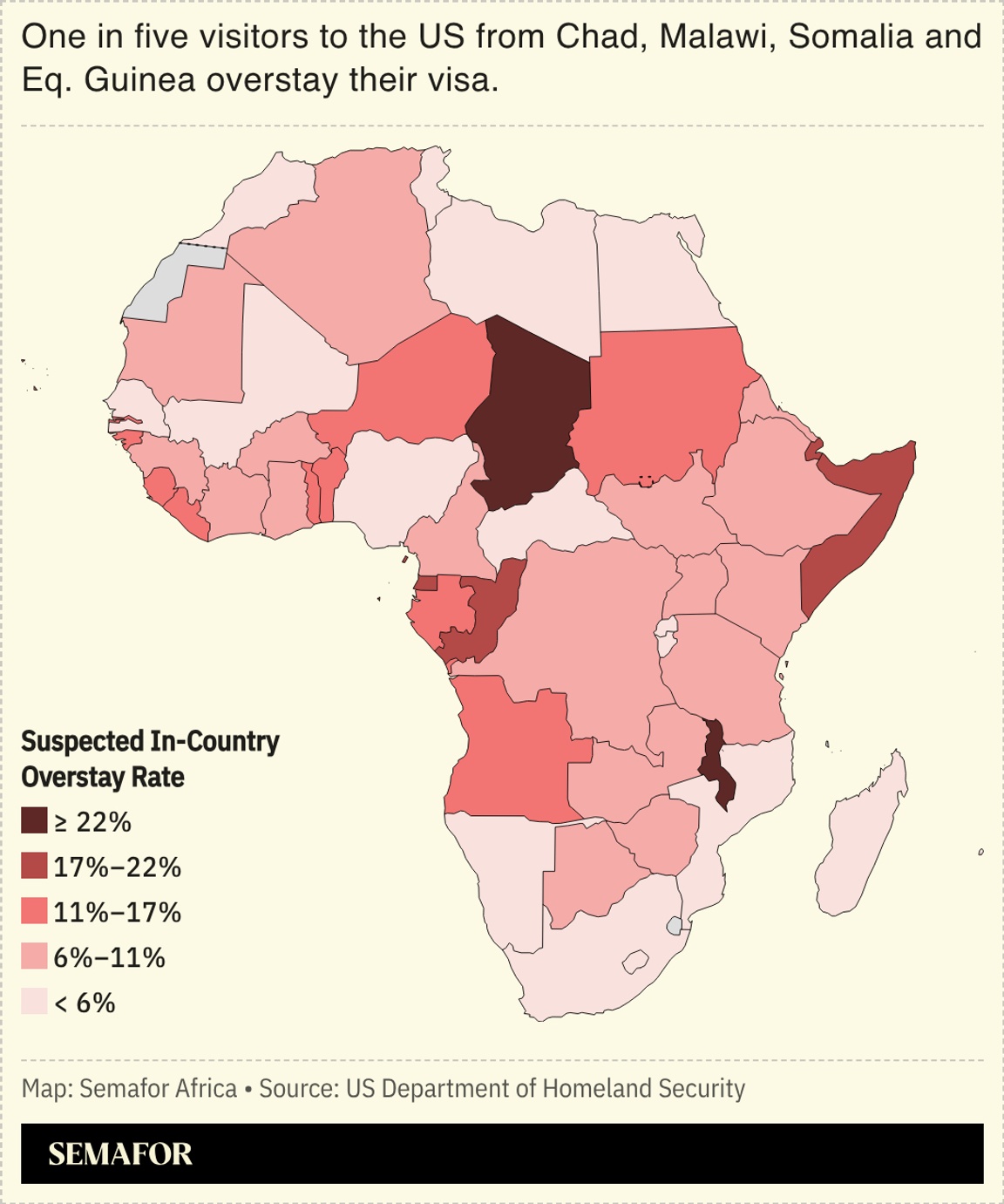 Washington has made permanent a pilot program requiring citizens of 50 countries — 30 of them African — to post bonds to obtain US tourist and business visas. Launched 12 months ago, the pilot program instructed consular officers to set a bond of $5,000, $10,000, or $15,000, “based upon the applicant’s circumstances.” Citizens from Nigeria, Ethiopia, Senegal, and Zambia were among those affected. In making the pilot permanent, the State Department also raised the maximum bond to $20,000 from $15,000, and eliminated the $5,000 tier. “Based on its extraordinary success in slashing overstays from bonded countries to near zero, the State Department has made the Visa Bond Program permanent,” a US State Department spokesperson told Semafor. The crackdown coincides with a US pressure campaign for African governments to accept deportees from other nations. Nigeria was one of the countries that publicly refused to accept non-nationals. |
|
Nigeria raises military salaries |
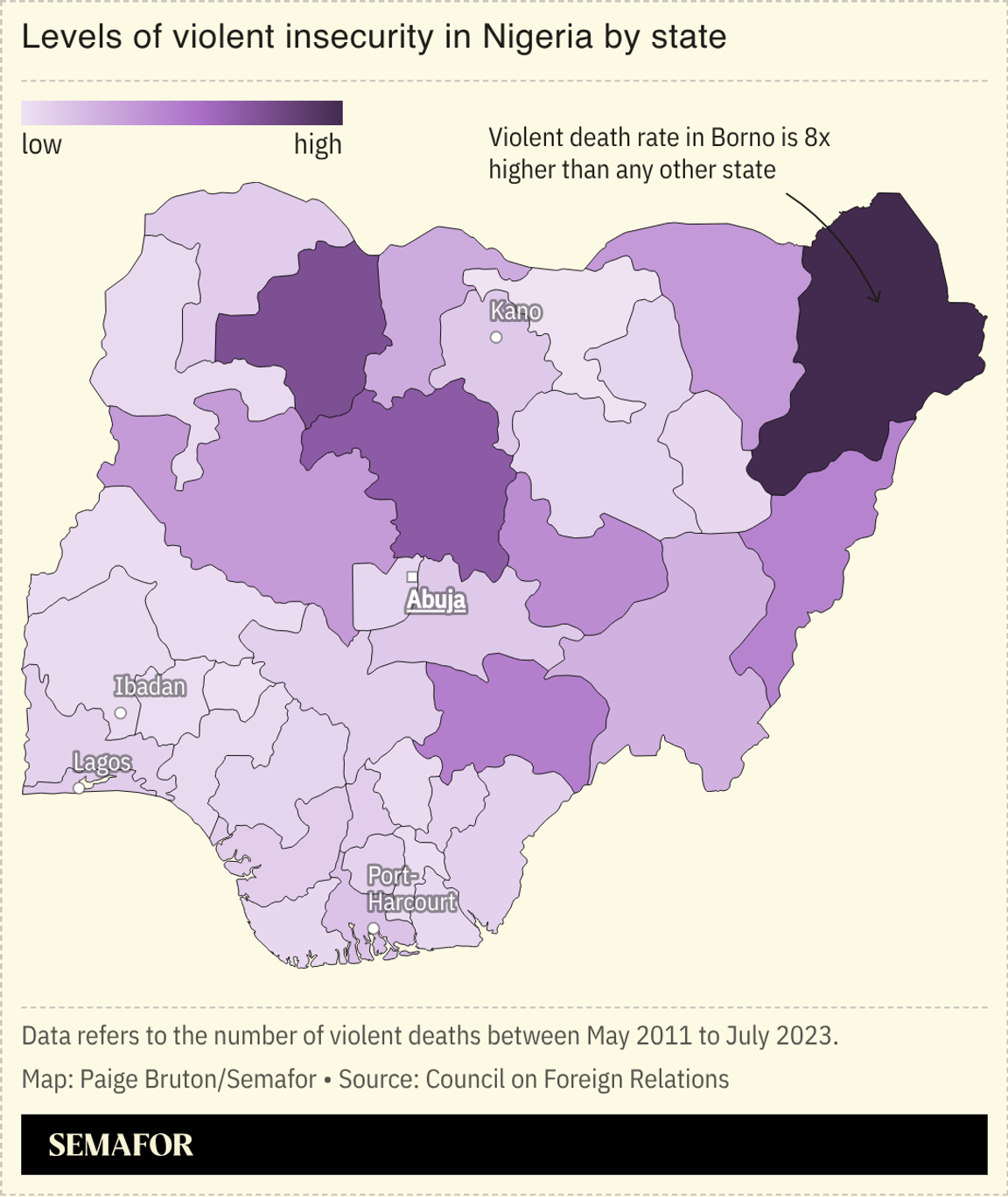 Nigeria will raise the pay packages of military officers across all levels, offering fresh motivation to army personnel who are battling multiple security threats. Insurgent groups, such as Boko Haram and Islamic State affiliates, have caused widespread instability in Nigeria’s northeast for many years. In addition to being under-equipped in terms of intelligence and logistics, Nigeria’s army has had a problem with poor remuneration that impedes counter-terrorism campaigns. The military has also been stretched by efforts to combat armed gangs carrying out mass kidnappings for ransom, and fighting between semi-nomadic herdsmen and settled farmers in states across the center of the country. The pay rises approved by President Bola Tinubu will affect a quarter of a million service members. Lowest-ranked officers are set to earn 80% more, while colonels and above get a 30% boost. The change will raise Nigeria’s salary bill for the army by 40% to $680 million, Tinubu’s office said. The move follows an alleged coup plot last year that has led to military officers facing treason and terrorism charges. It also comes months ahead of January’s presidential election, in which Tinubu will seek a second term. — Alexander Onukwue |
|
UAE ‘received $100M in stolen Sudan gold’ |
 Sudanese Rapid Support Forces display gold bars seized from a plane that landed at Khartoum Airport in 2019. Mohamed Nureldin Abdallah/Reuters. Sudanese Rapid Support Forces display gold bars seized from a plane that landed at Khartoum Airport in 2019. Mohamed Nureldin Abdallah/Reuters.The United Arab Emirates received more than $100 million worth of gold bullion that was stolen by paramilitary forces from the Sudanese central bank and its state refinery, according to a new investigation. Sudan’s brutal civil war has fueled the flow of gold — both legal and illegal — between the two countries; an Emirati official told the Financial Times the trade had reached just over $1 billion in 2025. The UAE has also become the main destination for conflict minerals from Sudan’s neighbor, the Central African Republic, according to an earlier report published in June. It places Dubai at the center of a lucrative trade in gold and diamonds tied to armed groups and foreign smuggling networks. Nearly $30 billion of undeclared artisanal gold is exported from Africa to Dubai each year, according to charity Swissaid. A version of this item originally appeared in Semafor’s twice-daily Flagship briefing. Subscribe here. → |
|
|
 Business & Macro |
|
|


