|
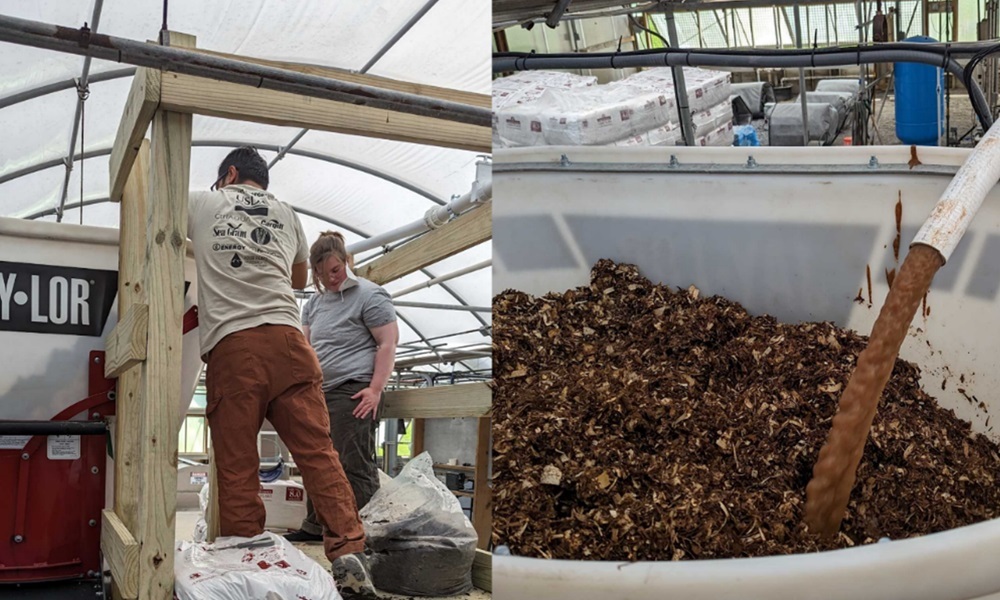
ARS Collaborator Dr. Abhinav Choudhury supervises aquaculture waste, mixed with wood shavings, to create a plant-safe fertilizer through composting. (Photo credit: ARS collaborator Dr. Abhinav Choudhury, The Conservation Fund’s Freshwater Institute)
Aquaculture Waste Opens Doors for Additional Revenue for American Fish Farmers
ARS researchers are finding new revenue streams for America’s fish farmers. Fish farmers who routinely work with recirculating aquaculture systems (RAS) often have a difficult time managing solid waste on their farms. There’s value in the waste, but obtaining that value can be a challenge. While solid waste from RAS is rich in organic matter and nutrients, it can lead to odors, be detrimental to plants in its raw state, and become costly to dispose of properly.
Scientists at The Conservation Fund’s Freshwater Institute, in Shepherdstown, WV, investigated composting as a solution to stabilize the waste aquaculture solids, which could then be sold as a plant-safe fertilizer. Learn more...
The Agricultural Research Service is the U.S. Department of Agriculture's chief scientific in-house research agency. Daily, ARS focuses on solutions to agricultural problems affecting America. Each dollar invested in agricultural research results in $20 of economic impact.
|