
|
 |
So you read this newsletter, but you haven’t purchased a paid subscription. There are two possibilities:
1. You just can’t afford the price of a subscription ($50/year or $6/month) right now. If that is the case, we get it! That’s exactly why Popular Information does not have a paywall. We want everyone to have access to our work, regardless of their financial resources.
2. You value independent accountability journalism and understand why it is critical to preserving and protecting democracy. You have thought about supporting Popular Information, but you just haven’t gotten around to it. That’s how it goes — life is busy.
But maybe today is the day! It takes a minute, and paid subscribers are the entire reason this newsletter exists. Popular Information has no corporate owners or billionaire backers. We count on readers like you.


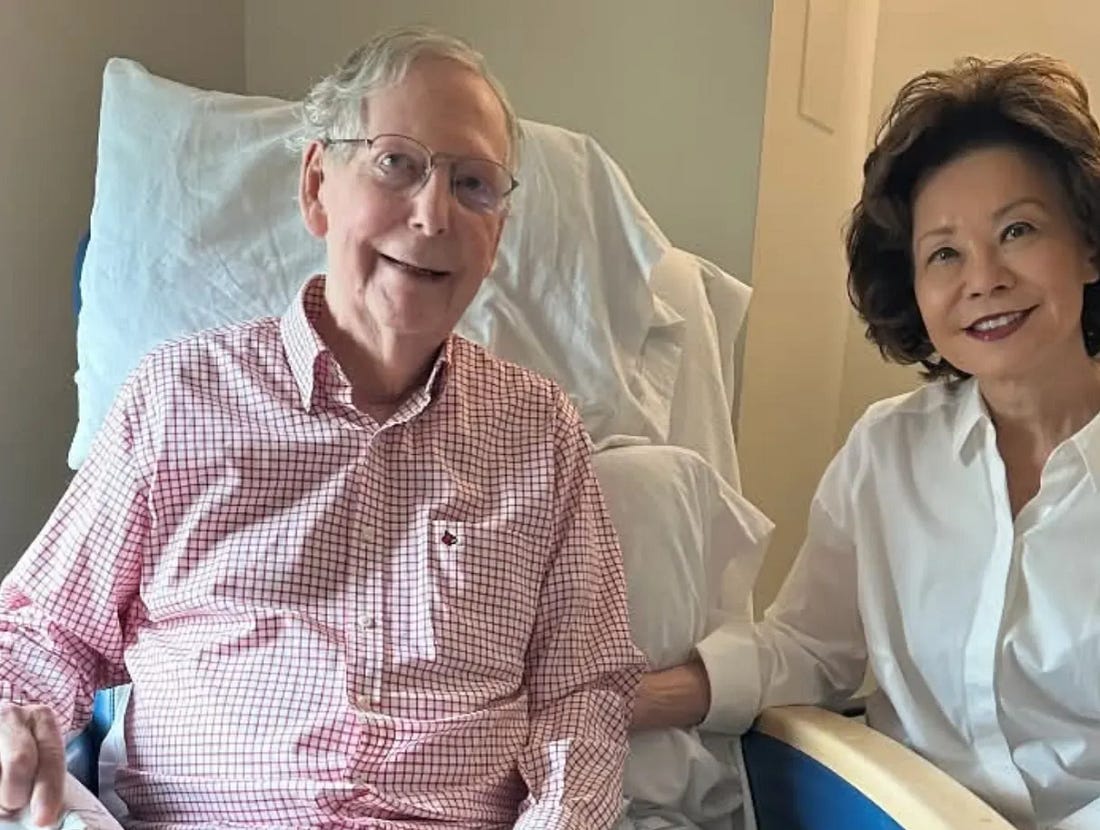 |
Senator Mitch McConnell (R-KY) was hospitalized on June 14 after suffering a fall that left him unconscious. He remained hospitalized until mid-July, when he was transferred to a rehabilitation center. On August 6, McConnell announced that he was discharged and was continuing his recovery at home.
But, two months later, McConnell has not returned to work in the Senate. Over that period of time, he has missed 59 floor votes. Nevertheless, McConnell has continued to receive his Senate salary of $174,000 per year.
McConnell is fortunate to be employed in a job with excellent benefits. There is no federal law, however, that provides guaranteed paid sick leave. In 2025, about 27 million private sector workers had no paid sick leave.
One reason: Mitch McConnell.
Since he entered the Senate in 1985, McConnell has voted against creating or expanding medical leave — paid and unpaid — at least 23 times.
Notably, near the beginning of his tenure, McConnell supported the Family and Medical Leave Act (FMLA), which provided up to 12 weeks of unpaid medical leave to care for yourself, a child, a spouse, or a parent. On June 14, 1990, McConnell delivered a floor speech declaring that the law was necessary “to promote the well-being of American families.”
The Senate approved the FMLA by voice vote the same day. But it was vetoed by President George H. W. Bush.
A year later, however, the Senate took up the FMLA again and McConnell reversed his decision. “I understand the reason for the Family and Medical Leave Act. We need to protect employees, and strike a balance between the needs of the marketplace and the needs of individuals who work in that marketplace. That was my reason for supporting similar legislation last year, although no recorded vote ever was taken on the issue,” McConnell said in 1991. “Today, however, we are mired in a continuing recession. Our Nation’s economy is in feeble health, its fiscal arteries clogged by tax increases and massive regulatory burdens.”
McConnell declared that he “cannot support any massive work force mandates like the measure before us today” and urged his colleagues to “revisit this issue when the economy is on a sounder footing.”
In the 35 years since, McConnell has never again voiced public support for medical leave and consistently opposed efforts to expand paid and unpaid medical leave.
McConnell’s long record of opposing medical leave
In October 1988, McConnell opposed a cloture vote on the Parental and Medical Leave Act, the precursor to the FMLA, which would have provided eligible employees with unpaid leave for a new child, a child with a serious illness, or for a serious health condition. In September 1988, McConnell also supported an effort to delay the legislation.
After his initial support in 1990, McConnell spent years opposing efforts to pass the FMLA and supporting amendments to weaken the bill. In 1991, McConnell opposed an amendment to create the FMLA of 1991. The same year, McConnell supported an amendment that would have required employees to enter arbitration procedures if their employer violated the law. McConnell also supported the Republican alternative to the bill, the American Family Protection Act, which did not guarantee medical leave. In 1992, McConnell voted against overriding Bush’s veto of the FMLA.
In February 1993, McConnell voted against the FMLA again, which was ultimately signed into law by President Bill Clinton. During consideration of the legislation, McConnell supported at least six efforts to weaken the bill. For example, McConnell supported an amendment that would have instead provided tax incentives for employers that adopted “flexible family leave policies.” McConnell additionally supported an amendment that would have allowed employers to satisfy the FMLA requirements “by offering such leave as a benefit in a cafe