| | In today’s edition: the UAE tests how far it can really cut Iran off, a thinning pool of crude at se͏ ͏ ͏ ͏ ͏ ͏ |
| |  | Gulf |  |
| |
|
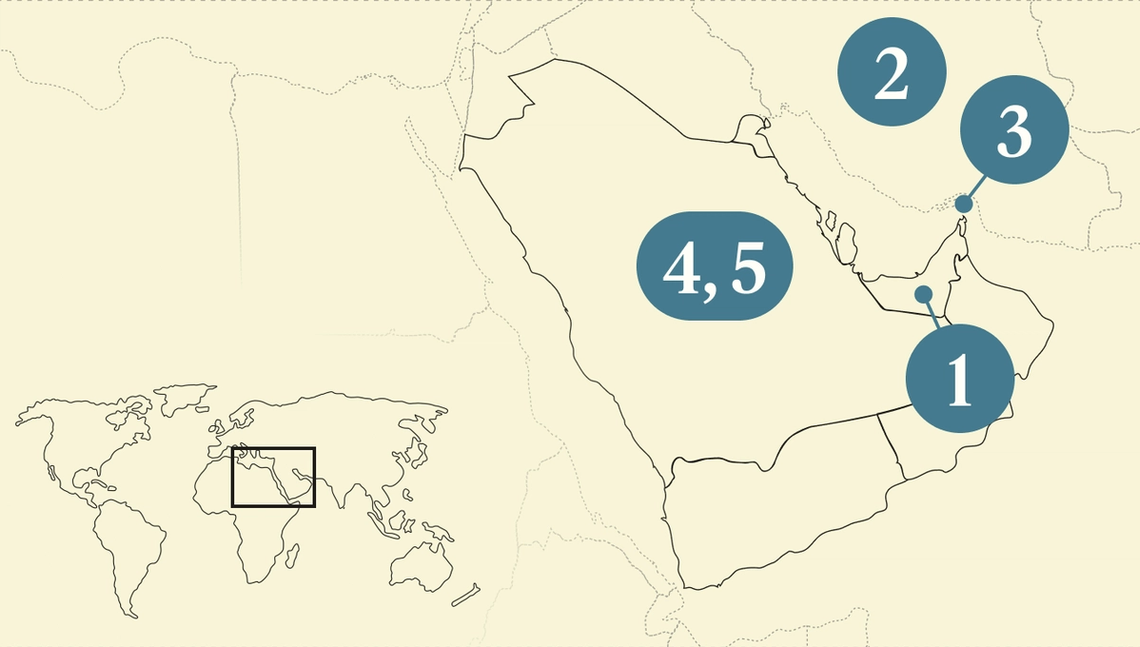 - UAE, Iran disentangle
- Asia’s coming crude crunch
- The night convoys of Hormuz
- HUMAIN laptop inbound
- SEVEN opens in Tabuk
 Saudi Arabia’s rewilding drive delivers its first striped hyena. |
|
 People walk the Grand Bazaar in Tehran. Majid Asgaripour/WANA via Reuters. People walk the Grand Bazaar in Tehran. Majid Asgaripour/WANA via Reuters.Cutting Iran off completely from the UAE could deal a serious blow to the Islamic Republic’s economy — but experts say disentangling the pair’s commercial ties could prove difficult. The UAE was Iran’s largest source of imports before the war, ahead of China, with two-way trade worth roughly $28 billion in 2024, according to the World Trade Organization. Further disruption could weaken the rial, push inflation toward triple digits, and deepen an economic contraction currently estimated at 5%, a former Iranian central bank adviser told CNBC. Washington is convinced of the role the UAE can play in choking Iran’s economy: The US told Emirati officials that targeting IRGC-linked money flows would hit Tehran harder than the naval blockade of Iranian ports, according to The Wall Street Journal. US sanctions orders show oil revenues, foreign-currency trades, and payments for Iranian entities historically moving through shell companies and exchange houses in Dubai, often with no Iranian name on the transaction, the Journal reported. |
|
‘Hormuz isn’t really the problem’ |
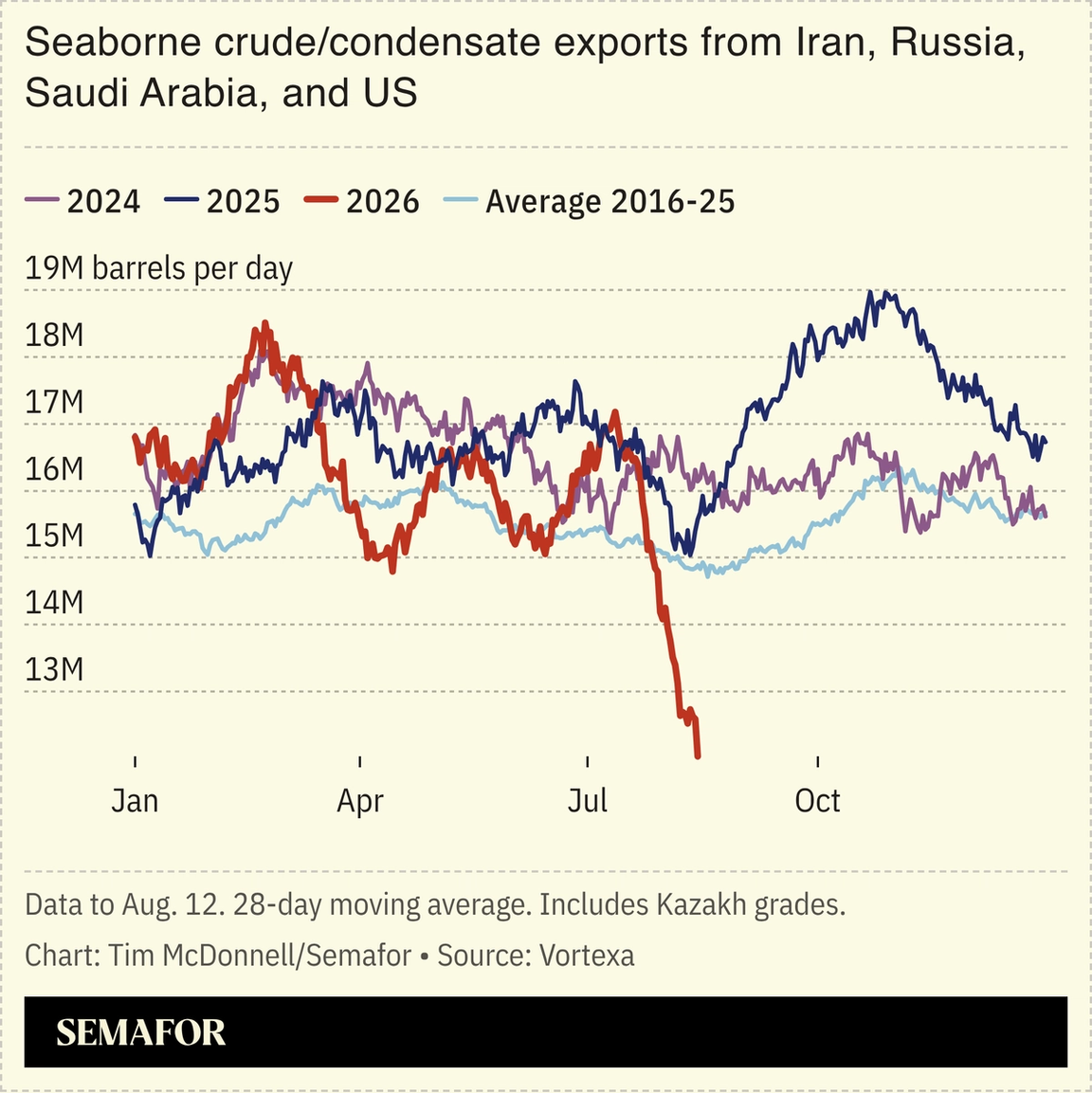 A big hiccup is moving through the global oil trade that’s likely to cause another surge in prices, especially in Asia, in the next few weeks. With oil tanker traffic out of the Gulf constricted over the past six months, higher exports from other countries, especially the US, have helped close the gap and keep prices lower. And there was an extra burst out of the Middle East during the short-lived ceasefire in June. Now the tankers that sprang out at that moment, including those from Iran, are reaching ports in Asia. But a number of other factors have conspired to drive down the volume of crude “on water” — that is, in a tanker — faster over the past two weeks than any point during the war, according to new data from the market intelligence firm Vortexa. So despite the US Navy’s efforts to push oil out along the Omani coast, “Hormuz is currently not really the problem,” David Wech, Vortexa’s chief economist, told Semafor’s Energy & Climate Editor Tim McDonnell. |
|
How the US is sneaking oil out |
 US Navy/Handout via Reuters US Navy/Handout via ReutersThe US military is reportedly shepherding 15 to 20 oil tankers in and out of the Gulf in scheduled convoys each night along a protected corridor that traces the southern edge of the Strait of Hormuz by Oman. Two US officials told Axios that close to 10 million barrels now exit the Gulf daily, though analysts cited by The New York Times put July flows on the protected routes closer to 5 million; prewar volumes were about 15 million. The US Navy has shepherded over 1,000 ships out of the strait since its efforts began in May, according to Central Command. As part of the operation, which followed a two-week military campaign aimed at degrading Iran’s maritime radar, ships typically switch off their transponders. It has not been safe, however: At least 15 ships on the route have been hit since June. “The Islamic Revolutionary Guard Corps can be a nuisance, but they don’t control the strait. We do,” one US official told Axios. |
|
 Tareq Amin/LinkedIn Tareq Amin/LinkedIn“Designed in the Kingdom of Saudi Arabia.” Packaging on a new laptop from HUMAIN bears this statement — in a not-so-subtle nod to Apple — seen in a teaser video posted by Tareq Amin, CEO of the Public Investment Fund’s AI firm. The device was built in collaboration with chip designer Qualcomm; more details (maybe even a launch date) are expected at LEAP, the technology conference beginning in Riyadh on Aug. 31. The device represents a big bet by HUMAIN to broaden its AI efforts, and pits it against some large players: Windows laptops are preloaded with Microsoft’s Copilot, for example. “Together with Qualcomm, we’ve been designing the next generation of the HUMAIN AI PC — bringing CPU, GPU, and NPU together to run AI models locally, on the device,” Amin said in the post. “The real question is: what operating system is running on it? ... What happens when we rethink the operating system for an agentic AI world?” — Kelsey Warner |
|
Saudi fun heads for the hills |
 Courtesy of Saudi Press Agency Courtesy of Saudi Press AgencyEven as some economic diversification projects are put on the back burner, Saudi Arabia is intensifying its $13.3 billion push to build indoor entertainment centers across the country. The kingdom is starting with its underserved second-tier cities, which are often in areas that attract year-round tourism because of their cooler climate. SEVEN, the Saudi developer owned by the kingdom’s sovereign wealth fund, builds indoor entertainment centers that bundle cinemas, bowling, karting, and rides: Its latest effort is in Tabuk, a northern city near the mountains that catch winter snow. There, SEVEN pairs Hot Wheels go-karts with a Discovery-branded adventure zone. The company’s multibillion-dollar program aims to create a longer tourism calendar to keep Saudis holidaying, and spending, at home. SEVEN plans at least three openings a year through 2028. |
|
 Culture- The bright yellow Al-Arfaj desert flower has become a symbol of resilience among Kuwaitis, hung from cranes and worn on lapels, as the country faces ongoing uncertainty because of the war in Iran. — Bloomberg
Energy Transition- Saudi Arabia’s renewables buildout is being squeezed by war-related equipment delays and pricier financing, leaving installed capacity at 12.3GW against a 2030 target of 130GW. Roughly half of project funding typically comes from abroad, and lenders are taking longer to commit, even with 25-year government power-purchase deals behind the projects. — AGBI
Tech- Young people in the Gulf are outpacing their global peers on digital skills: Almost one in three can program, while two-thirds know how to verify information online, according to GCC-STAT. Education spending in some Gulf states reached about 17% of government outlays in 2024, above the 12.6% global average.
|
|
After decades of hunting and poisoning thinned the species across the region, the first striped hyena cub has been successfully born in NEOM’s nature reserve. The birth follows the introduction of two breeding pairs into the park by conservationists hoping to rewild parts of Saudi Arabia. The scavengers play an important part in keeping ecosystems clean by feeding on carcasses.  Courtesy of Saudi Press Agency Courtesy of Saudi Press Agency |
|
| |