My friend, I am so sorry you’ve had your heart broken. What you’re experiencing is a universal, miserable experience, and while it will pass, that knowledge is little comfort when you’re going through it.
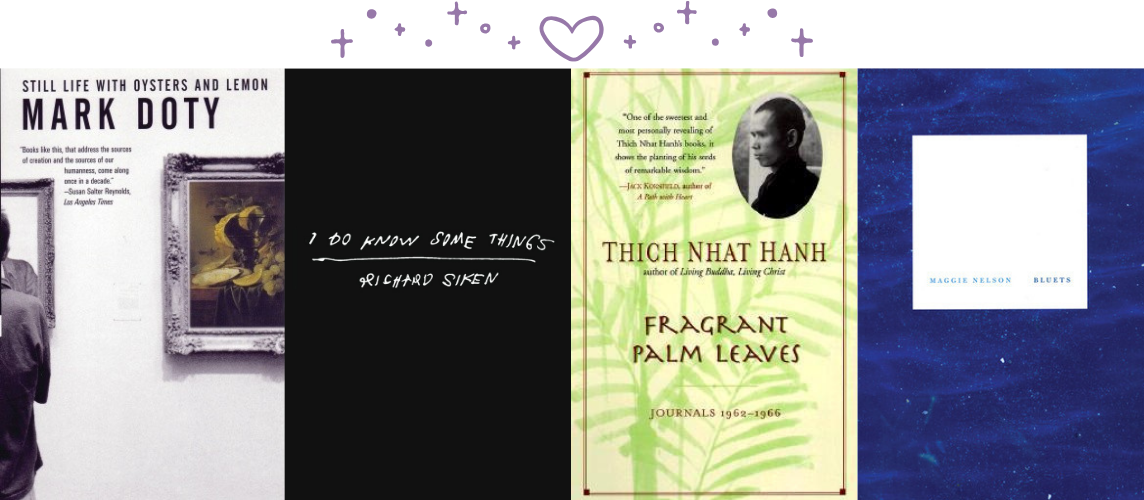
The trouble with heartbreak is there is no antidote—only palliative care, until time muffles the ache. That theme is explored in Mark Doty’s Still Life with Oysters and Lemon. Coming in at around 80 pages, it’s a short work of memoir-ish nonfiction about, well, life. It’s about memory, relationships, time, grief, art, the ephemeral nature of people and the less-ephemeral nature of love. It’s difficult to discuss a book this precise and beautiful without falling back on clichés, but if you want to feel less alone in your sadness, Still Life is a strong place to start.
If you enjoy the lyric prose of Doty, you may also want to dip into the prose poetry of Richard Siken. His devastating I Do Know Some Things, about getting dumped in the aftermath of a stroke, isn’t likely to cheer you up. That’s not the point. This book is for reading when you don’t need cheering up, you need someone to confirm the truth that life is sometimes just really, really sad.
This one’s a bit of a curveball, but you might want to check out Fragrant Palm Leaves: Journals 1962-1966, by the Zen Buddhist monk Thich Nhat Hanh. Look, most of us don’t want to absorb lessons about mindfulness or loving kindness when we’re destroyed by heartache, but Nhat Hanh’s journals primarily follow his journey into exile as he leaves Vietnam during wartime. Peppered throughout his diary entries are the sage’s early insights—enough wisdom to help ground you during this unmooring time, but you won’t feel you’re being lectured while you’re already down.
Because a heartbreak of this magnitude is an emergency, I tapped into our very own podcasts editor Drew Broussard to see if he had any additional recommendations. He suggested Bluets by Maggie Nelson, which I think is a great call. Bluets is a book about being sad, about being blue, about love and how much it sucks. It comes in short sips—the book is structured as a stream of numbered entries, most of which are a paragraph-ish, so it's easy enough to just read one or two at a time, something for the moments when you can stomach it. Then, like a good broth for a cold, it'll keep you coming back for more, slowly healing along with Nelson.
I hope at least one of these books helps you feel a little less alone, Dylan. Hang in there.
–Calvin Kasulke,
Associate Publisher