What matters in U.S. and global markets today

Start the day with Reuters on the stories moving U.S. and global markets. Subscribe for $1/week.


Morning Bid U.S.

Morning Bid U.S.

A Reuters Open Interest newsletter

What matters in U.S. and global markets today


By Mike Dolan, Editor-at-Large, Finance & Markets

World markets slipped into a holding pattern on Tuesday as investors tried to make sense of the noisy U.S. economic warfare that has dominated the start of the week ahead of the big macro events in the coming days. "Economic D-Day" in Iran underwhelmed, while Donald Trump's administration threatened even more levies on Canadian goods.

I'll get into that and more below.

But first, check out my latest column on how the massive AI buildout is amplifying U.S. fiscal concerns.

And listen to the latest episode of the Morning Bid daily podcast, where we discuss the Trump administration's multi-front economic battles as well as the latest round of tech ructions.

Subscribe to hear Reuters journalists discuss the biggest news in markets and finance seven days a week.


Data refreshes every time you open this email. For more U.S. market news, click here. Please send any feedback to morningbid@thomsonreuters.com.


Today's Market Minute

  • Iran promised to retaliate against expanded U.S. sanctions that the Americans said would cut Iran's economic lifeline, with Tehran expressing confidence that major trading partners would resist Washington's pressure campaign.
  • A roughly 45% slump in the shares of Unitree, China's best-known humanoid robot maker, since a more than fivefold jump on its Shanghai debut has triggered concerns about bubble risk, retail investor losses and flaws in the IPO system.
  • President Donald Trump on Monday threatened to raise U.S. tariffs on all cars, trucks and automotive parts from Canada to 50% starting January 1, 2027, escalating a trade fight after negotiations collapsed last week.
  • Move over Kevin Warsh. It's Treasury Secretary Scott Bessent who now appears to have a credibility problem, argues ROI Markets Columnist Jamie McGeever.
  • Following the Trump administration's underwhelming "economic D-Day," the real question is how Iran responds, argues ROI Asia Commodities columnist Clyde Russell.
 

Economic salvos

Treasury Secretary Scott Bessent’s plan to squeeze Iran’s economy via sanctions on countries and entities financing Tehran was shorter on detail than many had expected and essentially amounted to a warning shot to those still engaged with the country. The timeline for action also seems uncertain, but Iran said it would not be cowed and would retaliate against any measures.

Meantime, U.S.-Canada trade tensions ratcheted up further after 50% tariffs on $20 billion worth of Canadian goods came into effect. President Trump responded to Canadian retaliation with a threat to slap 50% levies on Canadian-made cars, trucks and automotive parts.

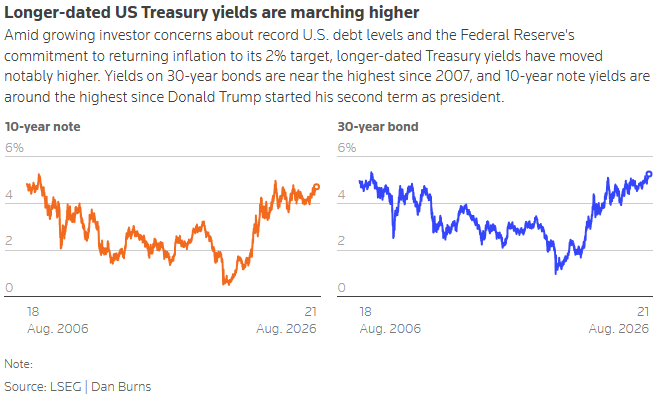
Both sets of headlines had little impact on markets, although Canada’s dollar did slip and Wall Street did end lower on Monday. A softer oil price kept a lid on Treasury yields.

Speaking of the bond market, Secretary Bessent's recent announcement of increased bond-buying got another negative review, this time from billionaire investor Stanley Druckenmiller, a former colleague of Bessent's at Soros Fund Management. In a Wall Street Journal opinion piece, Druckenmiller said debt management calculated to cosset the bond market around the midterm elections "spends the one asset that took two centuries to accumulate: the credibility of the Treasury market."

Back to equities, the U.S. stock retreat was led by weakness in tech, ahead of Nvidia’s results tomorrow. Tech ructions were felt in Asia as well, after a $10 billion share sale by China’s Alibaba to fund its AI plans knocked its stock down by 10%. Recent spectacular IPOs in China also backtracked, with robot maker Unitree’s shares losing almost half of the 600% rise clocked on its first day of trading earlier this month.

Wednesday is the first big macro day of the week, with Nvidia’s update preceded by U.S. PCE data for July. Today, investors get the August U.S. Consumer Confidence survey from the Conference Board, and 2-year Treasury notes come under the hammer.

With that, onto today's column.


The US fiscal hole has an AI problem at its core

Washington has a multitrillion-dollar fiscal problem. U.S. Treasury Secretary Scott Bessent's answer, so far, is to look for loose change down the back of the sofa.

His tentative nod to fiscal tightening last week has done little to reassure markets facing the highest U.S. government borrowing costs in decades — not least because the deficit's structural drivers, from mandatory social spending to falling corporate-tax revenues and a planned defense-spending boost, remain untouched.

Now the AI investment boom — and its uncertain payoff — sits at the center of both the short-term fiscal squeeze ‌and market unease.


Graphics are produced by Reuters.