Hello!
Today’s newsletter focuses on two major oil producing nations – Norway and the United States – and their plans to keep on drilling. We’ll first look at how Norway's government asked the country's supreme court to overturn a lower-court ruling that invalidated permits for three oilfields, in a closely watched case that could reshape how the country approves new petroleum projects.
Then we’ll unpack Norway’s latest move to continue developing its oil and gas resources in the Barents Sea regardless of the European Union's support for a moratorium on Arctic hydrocarbon supplies. And finally, we’ll turn to oil major Exxon, which is planning to grow its Permian Basin oil production by almost 40% to 2.5 million barrels of oil equivalent per day by 2030.
But before we drill into all that, please note that Sustainable Switch will be taking a break for the next two weeks, but I will leave you in the hands of my colleague Ross Kerber who will send a weekly edition on September 4 and 11. Also on my radar today: |
|
|
Haldis Tjeldflaat Helle, leader of Greenpeace Norway, poses for a picture outside Norway's Supreme Court, in Oslo, Norway. Picture taken with a phone. REUTERS/Gwladys Fouche |
Norway asks court to overturn banned oilfield permits |
For some brief context on what’s going on in Norway, we first have to go back to 2023.
That year, two lower courts ruled in favour of Greenpeace and Young Friends of the Earth against the government, finding that Norway failed to properly assess the environmental impact from Equinor’s Breidablikk and Aker BP’s Tyrving and Yggdrasil oilfield developments.
Now, Norway's government has asked the country's supreme court to overturn that lower-court ruling which invalidated permits for those three oilfields.
The lower courts have declined to order a halt to production while the legal process is ongoing and have also suggested that the government could seek to remedy regulatory shortcomings. "If we win this round, it could change Norwegian oil politics forever," Haldis Tjeldflaat Helle, leader of Greenpeace Norway, told Reuters outside the court.
"It means that Norwegian politicians will have to actually assess how many lives will be lost, how many forest fires will be created and how much ice will melt due to Norwegian oil." Norway produces around 2% of global oil and became Europe's largest supplier of natural gas after Russia's invasion of Ukraine in February 2022. |
Norway’s drive to drill in Arctic |
The court case comes as Norway is continuing to develop its oil and gas resources in the Barents Sea regardless of an EU policy against drilling in the Arctic on environmental grounds.
"In today's geopolitical and security environment, and given the resource situation, I believe continued activity in the Barents Sea serves both Norwegian and European interests," Energy Minister Terje Aasland told Reuters. Aasland believes Norway's arguments are being heard in Brussels but added that it was the country's sovereign right to develop the Barents Sea resources even if the EU continued to support a moratorium. "We would develop these areas, and then it will be up to the EU whether they should have a moratorium on buying that gas or oil," Aasland said. Critics of such a move argue that new Arctic projects would take many years to come online and would do little to address Europe's near-term energy challenges. |
|
|
|
Exxon’s push to pump more in the Permian Basin |
Exxon, the largest oil producer by volume in the U.S., operates more than 30 drilling rigs in the Permian Basin in Texas and New Mexico, the biggest U.S. oilfield, two of which are automated rigs with robotic equipment.
By 2028, the company aims to transition half of its fleet to automated rigs to reduce the need for workers to perform potentially dangerous work and increase efficiency to drill wells faster, an executive told Reuters.
Exxon plans to grow its Permian production by almost 40% to 2.5 million barrels of oil equivalent per day by 2030. By contrast, rival Chevron plans to hold production steady at about 1 million barrels of oil equivalent per day, focusing instead on free cash flow.
Exxon's use of automated rigs in the Permian and its goal of expanding the fleet has not been previously reported. The oil giant is also developing a suite of more than 40 technologies to double its oil recovery from the Permian by the early 2030s. |
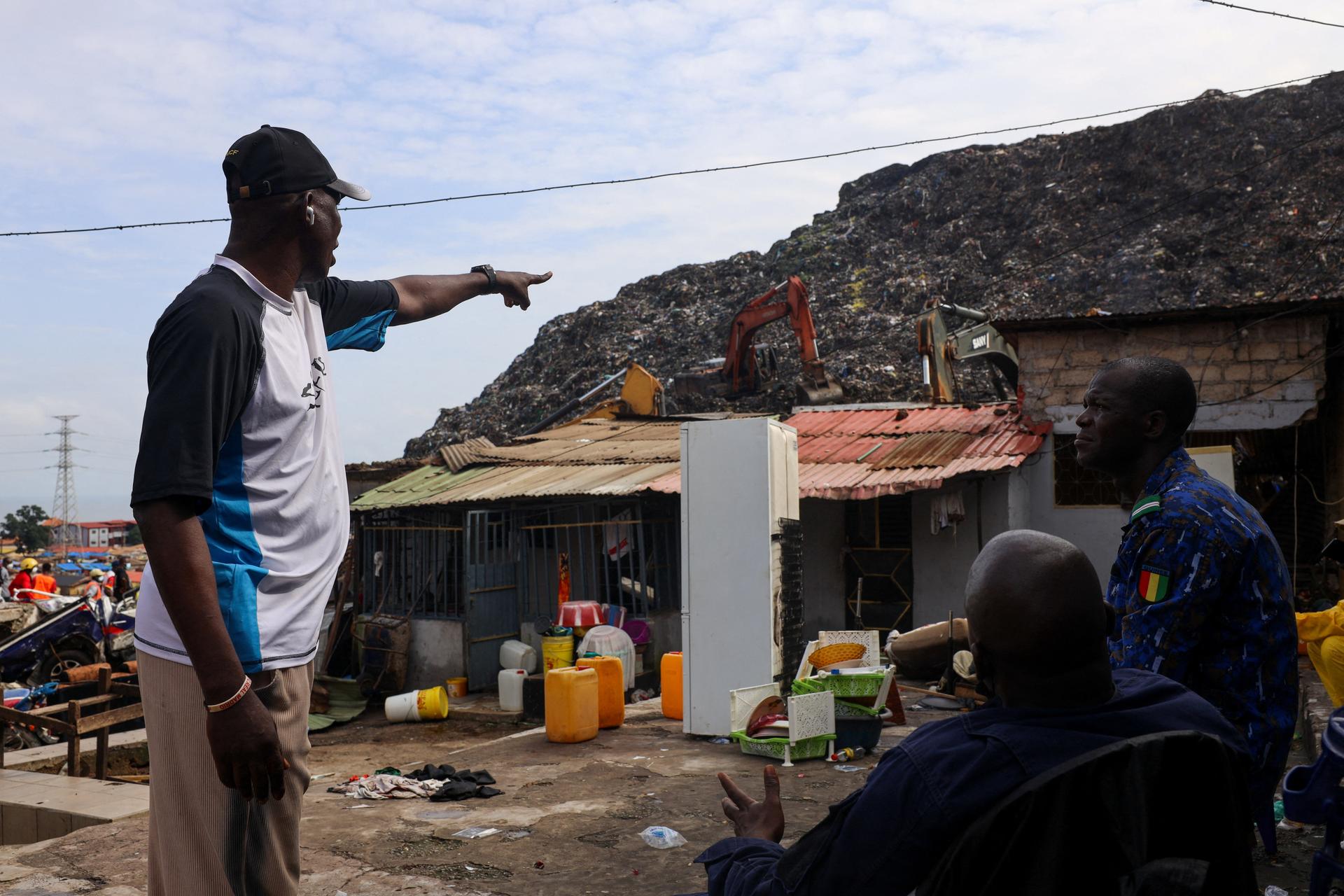
Lousseny Conde points at the landfill where he lost his five-year-old son and family members after a landslide near Dar es Salam, in Conakry, Guinea. REUTERS/Souleymane Camara |
-
Guinea’s landfill landslide: A landslide at a landfill in Guinea's capital killed 30 people on Sunday, according to a government statement, with six people seriously injured and 16 more lightly injured, the statement said. Heavy rains prompted the collapse of a massive mound of waste that engulfed nearby tents and shacks.
-
Typhoon Narra: Rising floodwaters triggered by heavy rain from Typhoon Narra have prompted China to relocate a total of 54,000 people in Guangxi, according to local media. Heavy rain is expected to persist across parts of Vietnam and southern China through Wednesday, with areas of Guangxi, Guangdong, Hainan and Fujian forecast to receive torrential rain.
-
Nevada wildfire: A wind-driven blaze has been threatening the city of Reno, Nevada, since the weekend, destroying dozens of houses and chasing tens of thousands of people from their homes. The wildfire erupted on Saturday near Nevada's third-most-populous city and raced through tinder-dry grass, brush and forest into residential areas. It was the second major wildfire to strike Nevada's Truckee River valley area in recent weeks. Click here for more.
-
Climate and health: Global warming is increasing the spread of tick-borne encephalitis and chikungunya viruses, the chief executive of vaccine maker Bavarian Nordic said. The diseases are moving north each year from its traditional stronghold in southern Germany, CEO Paul Chaplin told Reuters, adding that TBE was also increasing in Scandinavia as warming climate and milder winters cause tick populations to grow and spread.
-
Sustainable auto switch: Electric vehicle sales accelerated across much of Europe in July, according to data provided to Reuters. EV sales have soared in Europe since the Iran war began in February and caused pain at the pump. The big question for many in the auto industry is whether consumer interest will fade if and when oil prices retreat, while a lack of public charging options remains a major concern. Click here to learn more.
|
|
|
|
Roy Bedlow, CEO and founder of international renewable energy investment company Low Carbon, shares his thoughts on speeding up a sustainable switch: “Current market conditions are reinforcing existing trends in global energy markets rather than creating new ones.
“Energy security, exposure to price volatility and climate risk continue to strengthen the case for accelerating the transition to renewables, which remain the lowest cost and fastest to deploy source of new power. “The UK is a clear example of this momentum, with renewables supplying around 47% of electricity last year, more than any other source.
“That progress is significant, but rising electricity demand means the system needs to move faster. “Growth in AI, data centres and electrification more broadly are driving the need for large volumes of reliable, low carbon electricity, and that demand is unlikely to slow. “Beyond the noise from the oil and gas lobby, the investment case for renewables is clear.
“However, meeting that demand will depend on grid connectivity, flexibility and storage as much as generation capacity itself. “Storage investment, in particular, will be essential to balancing the system, managing negative pricing and ensuring growing power use does not translate into higher emissions.” |
A man in shorts walks on a street in New York City, U.S. REUTERS/Jeenah Moon |
|
|
|
|