Messy Mideast

Follow energy market shifts and the forces driving the transition to clean power. Subscribe to Reuters.com for $1/week.


Power Up

Power Up

A Reuters Open Interest newsletter

By Ron Bousso, ROI Energy Columnist

Data refreshes every time you open this email. For more energy news, click here. Please send any feedback to powerup@thomsonreuters.com.

Hello Power Up readers,

Just when energy markets thought things couldn't get any more complicated, they did.

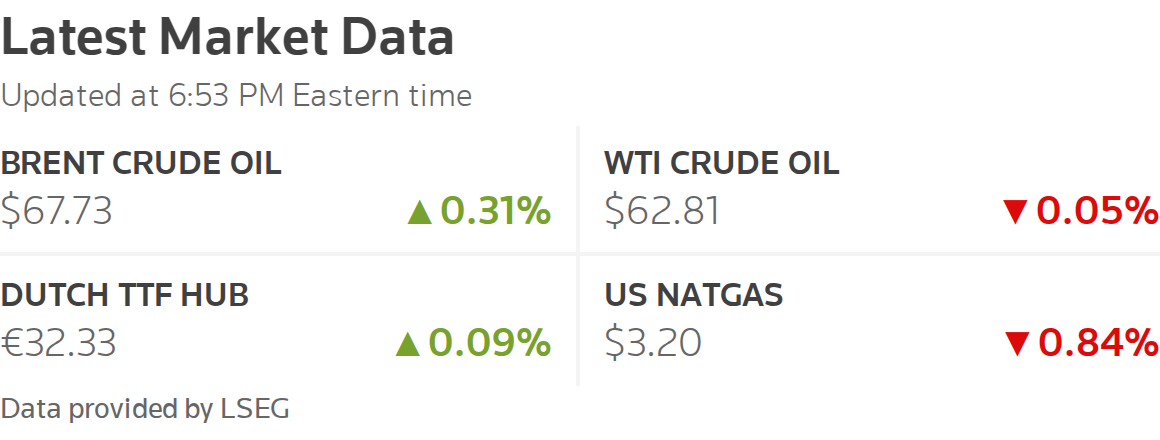
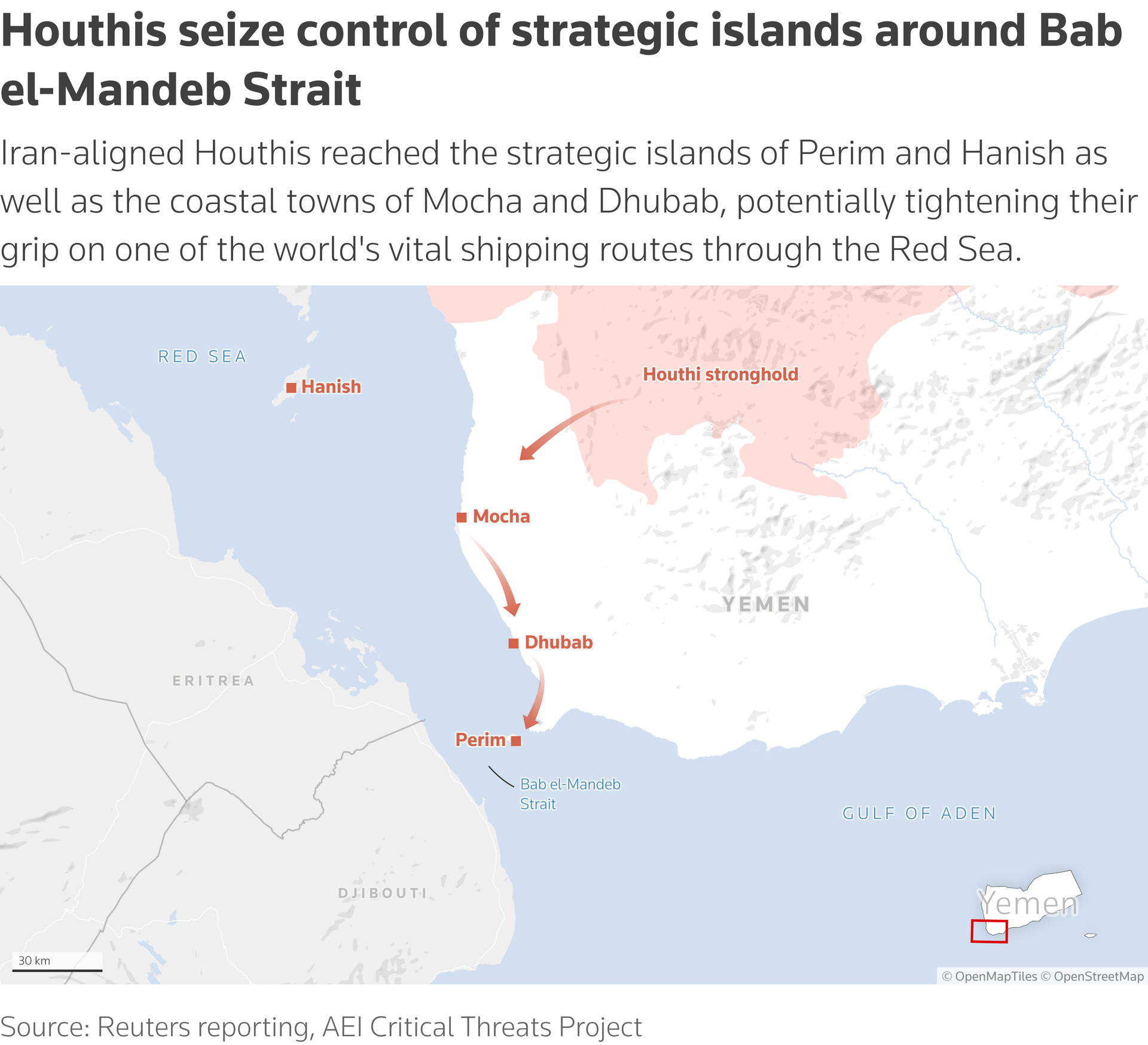
The Middle East conflict took another turn in recent days as Iranian-backed Houthi forces captured Yemen's Red Sea coastline, tightening their grip on the Bab el-Mandeb strait, while drone strikes on a key Saudi oil pipeline disrupted supplies equivalent to around 4% of global supply. Oil prices responded by climbing by over 3% on Monday to $108 a barrel.

Add in the collapse of talks between Gulf states on an Iranian-Omani proposal to regulate shipping through the Strait of Hormuz, and a sobering picture is emerging: this is no longer a short, sharp energy shock. Markets are increasingly pricing in a prolonged and unpredictable test of global economic resilience.

For more on that, check out my latest column.

As always, feel free to contact me at ron.bousso@thomsonreuters.com or connect with me on LinkedIn with any questions or thoughts.


Top headlines

  • Silent treatment: Arab states in the Gulf called off a meeting with Iran planned for Monday, while Yemen's Houthis launched a new attack on Saudi Arabia after fighting that has extended the Middle East war to another theatre and further jeopardised global oil supplies.
  • Dangote goes public: Nigerian billionaire Aliko Dangote on Monday launched Africa's largest-ever share sale, opening ownership of his giant refinery to retail investors and raising funds for further expansion.
  • LNG superpower: U.S. liquefied natural gas supply will continue growing and could account for roughly 30% of global LNG output by 2030, according to an ExxonMobil executive.
  • Two-tier oil market: Geopolitical disruptions are creating a huge price gap between crude that can move freely and barrels trapped behind logistical bottlenecks, explains ROI Asia Commodities Columnist Clyde Russell.
  • Rare earth, very rare politics: An obscure member of the rare earths family is going to be high on the agenda when China's President Xi Jinping meets with Trump later this month in Washington. ROI Metals Columnist Andy Home breaks it down.


Messy Mideast

The Iran conflict has become an increasingly awkward political problem for U.S. President Donald Trump ahead of November's midterm elections.

During a visit to Ireland on Sunday, which included both business meetings and a round of golf, Trump said he still expected the Iran war to end this year, possibly shortly after the midterms. When it does, he predicted, gasoline prices would "drop like a rock."

That may prove optimistic.

When the war will end is anyone's guess, but fuel prices look unlikely to collapse anytime soon. The Middle East conflict has severely curtailed global refining capacity, while months of Ukrainian drone attacks have left significant portions of Russia's refining sector damaged.

Indeed, Trump also urged Ukrainian President Volodymyr Zelenskiy to halt strikes on Russian diesel infrastructure after U.S. diesel prices surged to a record above $6 a gallon last week.

The White House clearly wants to draw a line under both the Iran war and the Hormuz standoff. For now, however, Tehran appears to have other ideas.


A marathon, not a sprint

With crude oil back above $100 a barrel, markets are entering a more difficult phase of the conflict.

Seven months ago, traders could still take comfort from healthy stockpiles, spare refining capacity and hopes that the disruption would prove temporary. Today, many of those buffers have either been depleted or exposed as thinner than they appeared.

The most striking example is global crude inventories. According to the International Energy Agency, oil stocks have fallen by 507 million barrels since the conflict began, equivalent to an average draw of roughly 2.8 million barrels per day.

To be fair, more oil has been moving through Hormuz in recent months than during the early days of the war. A growing number of vessels have been using a route along Oman's coastline under U.S. naval protection, allowing some exports to continue.

Kpler estimates that around 5 million barrels per day of crude and fuel products have transited the strait since June, roughly a quarter of pre-war levels. The true figure may be somewhat higher, however, as many tankers switch off their tracking systems while making the journey.

Even so, last week's Iranian attacks on more than a dozen tankers in and around the Gulf served as a reminder that sailing through Hormuz remains very much a high-risk business.

The question facing markets now is simple: how much longer can this balancing act continue before something breaks?

 
Read the full column