



 |
Noble gas
The Senate flew back into session this week after their long summer break. One reason for their urgency (and the resulting chaos) was that in the days just before the lawmakers reconvened, a whistleblower in the artificial intelligence industry dramatically claimed the frontier companies’ products were racing down the path of danger, where one of the possible outcomes is human extinction. (Just a slightly higher than 10 percent chance, though!)
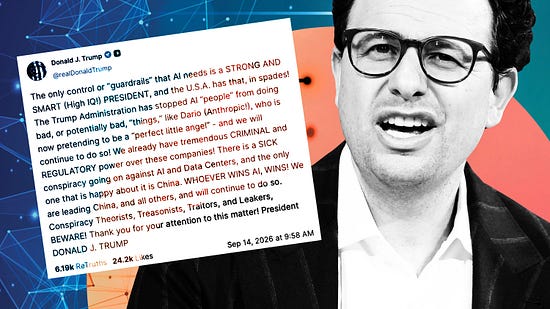
In response to the alarmist thread, the CEOs of the three major AI companies—Anthropic, OpenAI, and xAI—declared that America’s elected officials need to step in and install guardrails for their industry. President Donald Trump called this nonsense yesterday and claimed that the only thing necessary to prevent an AI apocalypse is a “STRONG AND SMART (High IQ!) PRESIDENT.” That didn’t instill a great deal of confidence on Capitol Hill, to put it mildly.
But as these nervy conversations continued to play out in public, I started to wonder if the AI leaders might have a less noble and more familiar goal in mind than preventing the end of the world: regulatory capture. Most senators I raised this possibility with either hadn’t considered it or refused to entertain the idea.
Regulatory capture is what happens when the government’s efforts to regulate a particular industry end up turning it into a kind of cartel economy where certain large companies are given protected status. It can occur for several reasons. Here are two important ones.
One is the revolving-door problem. Members of Congress will employ staffers who move in and out of the industries their bosses are responsible for regulating. It’s probably no surprise that the AI industry’s ranks of lobbyists and consultants are packed with former Capitol Hill staff from both parties, as well as former House members and senators whose terms have expired. Earlier this month, OpenAI also hired the daughter of Senate Minority Leader Chuck Schumer.
A second is that highly technical industries are often too complex for members of Congress to comprehend at a detailed level,¹ so they enlist the very industry insiders they are seeking to regulate to help them draft the regulations.²
When I spoke with senators who are working on this issue, some indicated they are taking seriously the possibility that a push for regulatory capture is already happening.
“That’s certainly something that members of Congress have to be mindful of,” Sen. Alex Padilla (D-Calif.) said about the possibility that AI executives have ulterior motives for their recent claims about the risks posed by their products. “Not just on Saturday, but going back a couple years.”
“Safety has to come first,” Padilla added. “That applies to everybody, large or small.”
“I mean, some of these CEOs are bankrolling efforts to try to stop states from regulating them,” Sen. Chris Murphy (D-Conn.) told me. “So it would be naïve not to doubt their sincerity.”
“We’ll eventually have to have something,” Sen. Tommy Tuberville (R-Ala.) said about advancing AI regulations in Congress. “Just like the internet. We had to figure out what it was about, how to handle it. But right now, we just need to make sure we do the right thing and understand it’s already here—it’s not coming.
“We need competition. A lot of this stuff—I think—comes from China, and it’s some kind of propaganda because they know that we’re into it pretty good. Whoever masters it will probably have an edge.”
Tuberville’s claim that the Chinese government is fueling AI fears and discontent in the United States has some evidentiary support.
You’ve reached the obligatory “support our work” box. We’ll spare you the hard sell. If you like what we do at The Bulwark, please consider being part of our community.
Other senators’ understanding of the issue seemed limited to either what they’ve heard while watching television news, or their own preexisting desires to regulate the AI industry.³
“To be honest, I hadn’t thought about that in the sense that . . . the interview I’ve seen seemed genuine,” said Sen. John Boozman (R-Ark.), probably referring to one of the interviews of whistleblower Jacob Coxon. “There’s real concerns not only from a few individuals, but across the spectrum. . . . It would be different if [the CEOs] were the only few raising the alarm.”
Sen. Jon Husted (R-Ohio) sidestepped the issue of regulatory capture, and instead used the auto industry as a metaphor to put responsibility back on the shoulders of the companies rather than lawmakers:
If an automaker made a car and they said, “Yeah, this car’s dangerous. Probably shouldn’t drive it,” well, you’d believe them, right? And they should never release that car. So these folks, if they really believe their product is dangerous, then they have an obligation not to release it.
Husted’s example might have made more sense if the auto industry hadn’t been the subject of regulatory capture case studies. It’s also notable that one of the AI CEOs in question is also an electric car mogul whose vehicles have been known to spontaneously combust.
Whether these CEOs are trustworthy is another open question. Elon Musk has made a habit of deceiving legislators and the public, demonstrated no remorse for the human lives lost as a result of his involvement in the government, and pursued a personal fortune unrivaled in modern history. A former board member at Sam Altman’s company described Altman as having an “almost a sociopathic lack of concern for the consequences that may come from deceiving someone.”
Of the three, Dario Amodei seems like the straightest shooter. Sen. Murphy credited the Anthropic CEO’s intentions over those of Altman and Musk.
“I think Dario is in a different position,” Murphy said. “He clearly has been more out-front about the dangers and more desirous of real regulation, but some of these other companies are actively funding efforts to try to stop regulation.”
Sen. Bernie Sanders (I-Vt.), who has—often haphazardly—introduced multiple AI regulatory bills, told me he has no qualms about trusting the stated intentions of these CEOs at the moment.
“Bottom line is, these guys know more about this technology than anybody in the world,” Sanders said. “I think it’s a good idea to listen to them when they talk about the possibility that AI will escape human control.”
What happens next on the legislative front is an open