





 |
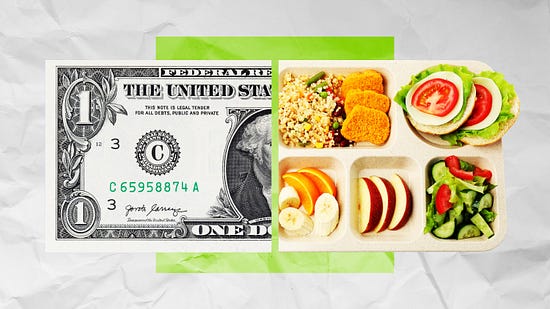
ONE OF THOSE NEW LEFT-OF-CENTER POLICY INCUBATORS you keep hearing about is unveiling its latest proposal: a sweeping plan to make lunches and breakfasts free to all public school students in America, regardless of income.
The idea, put forward by the Searchlight Institute, represents the latest attempt by the group to construct a new, slightly heterodox agenda for Democrats in the ramp-up to the midterms. If adopted, the group believes, the proposal could alleviate a major symptom of childhood poverty, giving those kids a better chance of succeeding in school, while also providing a public service that would benefit families from all incomes.
It would also represent a significant expansion of the current federal school meal program, in which only children from the poorest families and certain qualifying communities get free meals. Children in other families have to pay part or all of the cost, depending on household income levels.
The idea is “new” in the sense that it has not been a major feature of Democratic agendas in the past. But the concept has been promoted for years by some advocates, especially the Food Research and Action Center. And it’s even gotten a trial run: The federal government subsidized free meals for all schoolchildren during the pandemic, thanks to a series of congressional and agency actions that started when Donald Trump was president in 2020.
The authority and funding expired in 2022. But nine states have continued or restarted free school meal programs on their own, arguing (among other things) that universal programs do a better job of reaching all the kids truly in need while reducing stigma and the costly administrative hassle of checking every family’s eligibility.
Now Searchlight wants to take that idea national, arguing that it would have long-term effects on the well-being of children while providing tangible relief to families struggling with the daily cost of living.
“Preparing the school meal for your child is becoming more expensive,” Scott Moore, the Searchlight policy associate who is the proposal’s chief author, told me in a phone interview. “It is in my view both virtuous and probably the most efficient to allow these meals to be served free . . . and we can lower that cost burden for a lot of families.”
The idea comes with plenty of questions and would entail plenty of tradeoffs. Cost is at the top of the list. Offering free breakfast and lunch to every public school student in America would require at least a few billion dollars a year in new federal spending—not a huge sum, all things considered, but enough that it would be competing for resources alongside other worthwhile-sounding initiatives. Plenty of lawmakers, advocates, and voters are going to ask why taxpayers should be shouldering the cost even for middle- and upper-income families who could pay for it on their own.
One answer to that question is that society has a vested interest in supporting all children, not just the needy, because it’s a way of investing in the next generation of citizens, workers, and public servants. And if that notion sounds radical, it shouldn’t. It’s one of the reasons America has free public schools in the first place—and, as it happens, one of the reasons the federal government got into the business of funding school lunches.
You don’t have to cross the aisle. You don’t even have to leave your chair. Just join the side you’re already on—join Bulwark+ today.
THE SPECTER OF WAR loomed large in May 1941, when Franklin Roosevelt’s administration convened a National Nutrition Conference for Defense. The federal government had been purchasing and then distributing food to schools on a limited basis since the 1930s, partly to sustain farmers during the Great Depression and partly to alleviate extreme hunger—a mission, conference organizers noted in their preamble, that they had largely accomplished. “Few actually starved,” they wrote.
But, they went on to say, “a guarantee against starvation is not enough.” And nobody agreed more than Lewis Hershey, a World War I veteran whom FDR promoted to brigadier general and tapped to run the selective service. Draft boards were deeming about 40 percent of the men they saw unfit for general military service, Hershey reported, thanks to a variety of mental and physical limitations that ran from vision problems to severely low weight. And “perhaps one-third of the rejections were due directly or indirectly to nutritional deficiencies,” Hershey warned.
He described the situation as “a condition we should recognize as dangerous and which we should take immediate, positive and vigorous measures to correct.”
Congress responded with a series of wartime appropriations to help finance school lunches. Then, in 1946, it sent President Harry Truman legislation creating the National School Lunch Program, which its chief Senate sponsor—the Southern, pro-segregation Democrat Richard Russell—predicted would do more to promote education than anything “since the creation of free public schools.”
Truman signed it, and today the program is the nation’s second-largest food program, behind only the Supplemental Nutrition Assistance Program (SNAP). The school lunch program provides funding to states that agree to provide lunches following federal guidelines on eligibility and nutrition, with some combination of state, local and private money covering some of the cost as well. Roughly 91 percent of the country’s 99,000 public schools participate, and as of 2024, the program was providing meals to more than 29 million school children on a typical day, at a discount or with no charge for more than 21 million of them.
That percentage of children getting free or discounted lunch was close to its pre-pandemic peak, and reflected a series of enhancements over the decades—some through legislation, some through executive action—designed to make sure the program was reaching all the kids who needed help. One of the most important reforms allows states to automatically enroll children if they or their families are already eligible for other means-tested programs, like Medicaid or SNAP.
But kids have been falling between the cracks even with these provisions in place. Not every family eligible for other assistance programs opts into them, meaning their kids don’t end up with free meals automatically. And automatic enrollment works inconsistently. In the many cases where families need to file paperwork, it might be confusing and difficult, plus parents may not even realize the discounted and free meals are available.
“In talking to community members over the years, a lot of people don’t realize that you can actually apply for free or reduced meals at any time during the school year,” Jennifer Gaddis, a professor