
|
Alito and Thomas keep the pedal to the metal
Their mail voting dissent is legal hackery. But it makes sense politically.
|

| |||||||||||||||


 |
PN is supported by paid subscribers. Become one ⬇️
On Monday night, the Supreme Court finally blocked Trump’s plan to unleash chaos on the midterms and disenfranchise millions of voters. In a 7-2 order, they barred the Post Office from inserting itself into the mail-in ballot process.
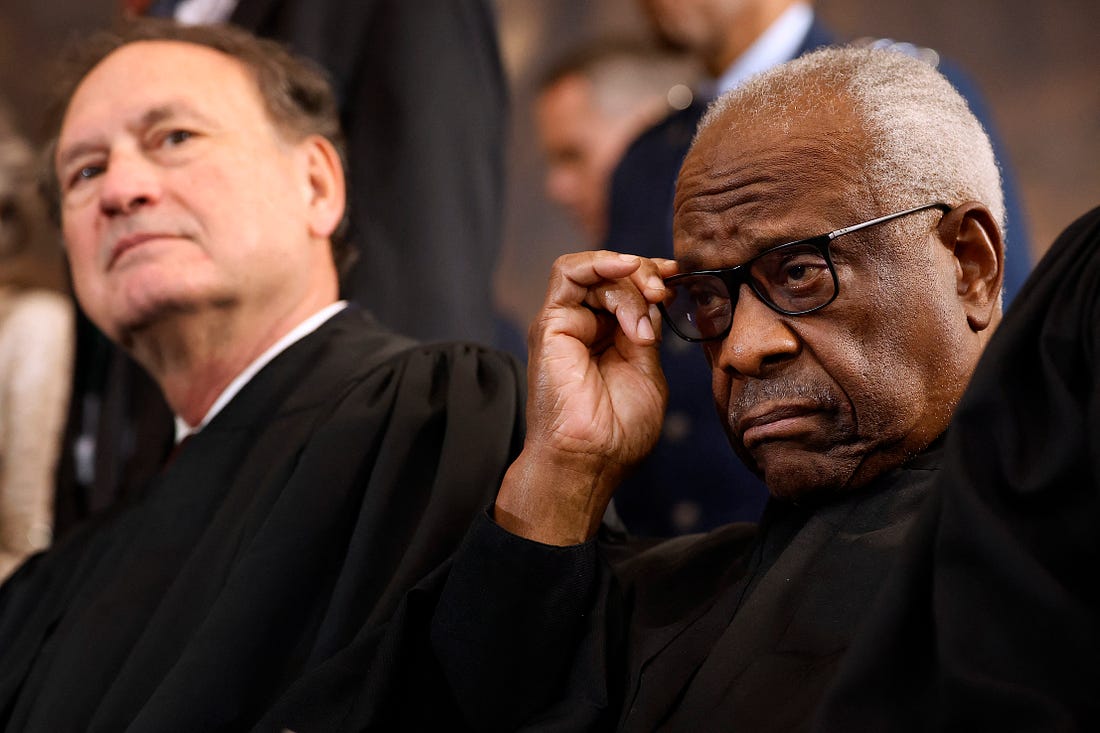
All three of Trump’s own appointees sided with the liberals and Chief Justice Roberts, leaving Justices Alito and Thomas alone in bitter dissent.
Naturally, Trump spent yesterday morning screaming about this act of betrayal.
“These are not the people I interviewed to serve on the United States Supreme Court, they are merely a shell of their original selves,” he whined, adding that “It is not easy for me to write this criticism of the United States Supreme Court — it will likely cost me dearly for years to come — but I feel it my obligation and duty, as President, to do so for the America we love!”


Executive disorder
On March 31, Trump signed an Executive Order mandating fundamental changes to the way the Post Office handles mail-in ballots. States would be required to pre-submit lists of all voters receiving ballots and purchase envelopes with an Intelligent Mail barcode (or IMb) assigned to each individual voter. The Post Office could refuse to deliver ballots to anyone not on the list or anyone the government decided shouldn’t be voting.
Even if this plan had been operationalized the very next day, it would have been too late.
Most states send out their mail-in ballots 30-45 days before the election. Envelopes and ballots must be ordered and printed months in advance, and it takes weeks to stuff those envelopes and ready them to go out.
As the County Clerk for Texas’s Travis County attested, preparing the county’s mail-in ballots takes 35 people working full-time for five weeks, ballot envelopes have to be ordered between three and six months in advance, her office has no IMb scanner, and she has no budget to cover the purchase of a new scanner or replacement envelopes.
But Trump’s order did not go into effect immediately. Instead the Post Office was given 60 days to come up with a proposed rule, after which there would be a mandatory period of public comment. On June 2, USPS published the proposed rule, which went into effect August 21, roughly ten weeks before Election Day.
Opponents of this policy immediately sought to vindicate their rights. On April 1, a raft of Democratic organizations (DNC, DSCC, DCCC, etc.) along with the NAACP and LULAC filed suit in federal court in DC. And on April 2, a coalition of 24 blues states, the District of Columbia, and the League of Women Voters sued to block the rule in Massachusetts.
 |