|
Dear all,
UKHSA Conference 2026 has just wrapped up in Manchester. Delivered in partnership with the Faculty of Public Health, the conference brought together the health security community for two days of cutting-edge science, innovative practice and dynamic discussion.
This special edition of the Stakeholder Cascade shares the key activity from Manchester Central with our stakeholders. This includes summaries of the keynote addresses, press releases and other highlights.
Links to our latest communications toolkits and webinars can be found further down the bulletin.
You can follow UKHSA on X, on BlueSky, and on LinkedIn for all the latest updates. News from the UKHSA can be found on our news page on GOV.UK.
As always, if you have any questions please get in touch by emailing externalaffairs@ukhsa.gov.uk.
Best wishes,
UKHSA External Affairs Team
Activity from conference
Tuesday 22 September
- Welcome address from Dame Diana Johnson, Minister for Public Health and Patient Safety, Department of Health and Social Care
- UKHSA Chief Executive opens conference with keynote on the importance of partnership working
- UKHSA and University of Oxford scientists uncover genetic changes in the bacteria causing severe Kent meningococcal disease outbreak
- Sir Andrew Pollard speaks to the importance of vaccines as social justice
- UKHSA and PACE make new bacteria available to support research into tackling antimicrobial resistance
Wednesday 23 September
- Foolproof health: tackling misinformation with prebunking
- UKHSA expands wastewater surveillance to strengthen ‘early warning system’ for dangerous pathogens
From our stakeholders
- Faculty of Public Health Member Survey
Ongoing issues
- Latest UKHSA communications toolkits
- Upcoming webinars hosted by UKHSA and partners
UKHSA data, analytics and surveillance
- Statistics at UKHSA
- UKHSA data dashboard
- Notification of Infectious Diseases report

Dame Diana Johnson, Minister for Public Health and Patient Safety, addressed delegates on the vital role of public health surveillance, systems and partnership working in keeping the public safe.
She praised the public health community for the surveillance systems, cutting-edge science, vaccine research and strong relationships that underpin the UK's ability to detect and respond to health risks, citing domestic and international efforts on threats including meningitis, hantavirus and Ebola. She stressed that public health is fundamentally about enabling people to live their day-to-day lives safely and resiliently.
The Minister emphasised that investment must look both to today's response capability and tomorrow's, with pandemic preparedness and earlier detection of threats essential to ensuring the country is ready for future outbreaks and health emergencies. She confirmed the government's continued support for innovation across the sector, framing it as central to building a fairer and more resilient country.
|
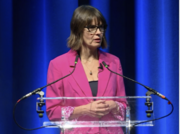
Professor Susan Hopkins, Chief Executive of UKHSA, addressed Conference on the power of partnerships in delivering health security and thanked the public health community for helping to meet the public's expectation to be kept safe.
She highlighted working with communities and partners as the best way to keep people safe and healthy, pointing to the role of local government in increasing vaccine uptake, meningococcal responses in Dorset and Kent, a hantavirus response spanning collaboration across 28 countries, and the work of sexual health teams to tackle STIs as examples of partnership working in practice.
Professor Hopkins focused on the changing nature of threats, particularly around climate, technology and infectious disease. She spoke of the importance of connecting systems that were once separate, and how this has enabled the public health community to move more quickly to identify and respond to threats. She stressed the importance of fostering trust with communities and the need for industry and academia to support reaching the public.
She said the sector is collectively focused on moving faster from discovery to protection, on seeing threats earlier, learning faster, building expertise and responding decisively, ideally before a threat becomes a crisis, all underpinned by building trust between people and organisations. She closed by reflecting that UKHSA is at its best when it is part of something bigger.
|

Scientists from UKHSA, the University of Oxford and a collaboration of academic institutions have used bacterial genome sequencing to understand why the meningococcal disease outbreak in Kent earlier this year was so severe.
Their findings, published as a pre-print yesterday (Tuesday 22 September), reveal that the outbreak bacteria had picked up genetic material from other, less harmful bacteria found naturally in the throats of many healthy people. This process is called ‘horizontal gene transfer’ and allows bacteria to pick up and incorporate small pieces of DNA from other bacteria in their environment, effectively borrowing genetic traits without direct reproduction taking place.
These genetic changes appear to have altered how the bacteria interact with human cells, making this particular strain unusually effective at causing severe disease and potentially less well recognised by human immune responses. However, the same changes that made it so dangerous may also explain why it has not continued to spread widely since the outbreak was brought under control.
The research was presented today at UKHSA's conference and underlines why the UK’s world-leading genomic surveillance and rapid outbreak response capabilities are more important than ever.
|

Oxford Vaccine Group's Sir Andrew Pollard set out a powerful case for vaccination as a matter of social justice. Globally, immunisation averts up to 5 million deaths annually, yet infectious disease remains the leading killer of children worldwide, with pneumonia the biggest cause.
Closer to home, he warned that UK childhood vaccination rates are declining, contributing to a rise in under-5 mortality since the pandemic. He noted deprivation remains strongly linked to poorer uptake and outcomes, with early childhood identified as the most effective, cost-efficient window for intervention.
Sir Andrew also highlighted global success stories, including the lives saved by the COVID-19 vaccine, and rapid progress on Ebola vaccine development. However, he cautioned that, globally, vaccine-preventable disease is still the major threat to children.
|

On Tuesday it was announced that UKHSA in collaboration with Pathways to Antimicrobial Clinical Efficacy (PACE), a partnership between Innovate UK, LifeArc, and Medicines Discovery Catapult, has made 5 new collections of drug-resistant bacteria available for researchers to order. This will allow new treatments and diagnostic tests to be checked against contemporary antimicrobial resistance (AMR) patterns seen in the UK and globally.
To check whether a new treatment is likely to work, researchers can test it against a panel of bacteria. Until now, few of these panels have reflected current resistance patterns, and getting access has often taken a long time before research could begin.
The samples are available through UKHSA’s National Collection of Type Cultures, along with detailed scientific data to support researchers.
|

Professor Sander van der Linden of the University of Cambridge, in conversation with BBC's Marianna Spring, explored why health misinformation spreads so effectively and what can be done to counter it.
Sander explained that misinformation often catches people at moments of vulnerability, with bad actors exploiting emotional, community and cognitive factors to draw people in. Once someone accepts one conspiracy theory, they become more susceptible to others, as belief becomes tied to identity and worldview. Simply correcting facts rarely changes minds; prevention is more effective than cure.
This is the principle behind "prebunking": exposing people to a weakened dose of misinformation techniques so they build resistance before encountering the real thing. Sander's game "Bad News" lets players experience manipulation tactics firsthand, and has reached over 200 million people through its follow-up, "Go Viral!"
Other strategies discussed included using humour and transparency to humanise institutions, involving trusted voices such as ex-conspiracy theorists, and holding social media companies accountable for algorithms that reward divisive content, rather than relying on blanket bans. Sander stressed that anyone can be vulnerable to misinformation, and reducing shame is key to keeping people engaged.
|

UKHSA announced today that their wastewater and environmental surveillance programme is expanding to strengthen the UK’s ability to detect pathogens with significant public health threat.
The new programme, called PRISM (Pathogen Risk Intelligence through Surveillance and Modelling), builds on the development programme for wastewater monitoring launched by UKHSA in April 2025. PRISM is expanding into an England-wide system, strengthening existing surveillance and the country’s ability to detect outbreaks.
PRISM has been designed to be pathogen-agnostic, meaning it has the potential to detect known threats, novel variations of known threats as well as previously undetected pathogens, all from a single sample.
Although viruses such as Crimean-Congo haemorrhagic fever, Ebola, Marburg and Lassa fever have not emerged in the UK, this new detection technology has the potential to identify these and other dangerous pathogens at an early stage, strengthening the UK’s biosecurity and pandemic preparedness.
You can read more on UKHSA's wastewater programme in our blog post.
|
The Faculty of Public Health has launched its Member Survey 2026, giving Faculty members the opportunity to share their views on the benefits and services the Faculty offers, and to help shape organisational priorities over the coming years
Faculty members can access the survey by logging in to MyFPH.
The survey takes around 10 minutes to complete and all responses are anonymous.
The UKHSA External Affairs Team prepares a range of communications toolkits to support stakeholders to communicate health security messaging to your networks. You can find the links to all our latest communications toolkits below:
We have a series of webinars coming up which may be of interest to you or your audience. You can find out more information and sign up by clicking the links below:
UKHSA collects and publishes statistics, data and analysis related to planning, preventing and responding to external health threats. This includes official statistical publications on COVID-19, immunisation, healthcare associated infections, other infectious diseases, mortality surveillance and sexual and reproductive health. These can be found on our statistics page on GOV.UK.
The UKHSA data dashboard provides a weekly summary of public health data. It has recently been updated to include Invasive Group A Strep, tick surveillance and hepatitis C data. Over time, the data dashboard will be expanded further to present a wider range of data on public health topics in line with the remit of the UKHSA.
The weekly UKHSA NOIDs publication is currently paused (from 3 April 2025) to make changes, including adding the |