| | Foreign investors pile into US funds at a record rate, Switzerland votes down stricter neutrality, a͏ ͏ ͏ ͏ ͏ ͏ |
| |  | Flagship |  |
| |
|
The World Today |  - Investors flock to US
- AI outruns governments
- US-China summit fallout
- Faltering US-Iran talks
- Netanyahu warned on Oct. 7
- US troops join Ecuador fight
- NATO gets Swiss boost
- Panama’s copper mine
- Cyberfraud ops spread
- Caviar prices plunge
 A new book lays out the battle over the world’s undersea cables, and a look at the week ahead. |
|
Foreign investors buy record US equities |
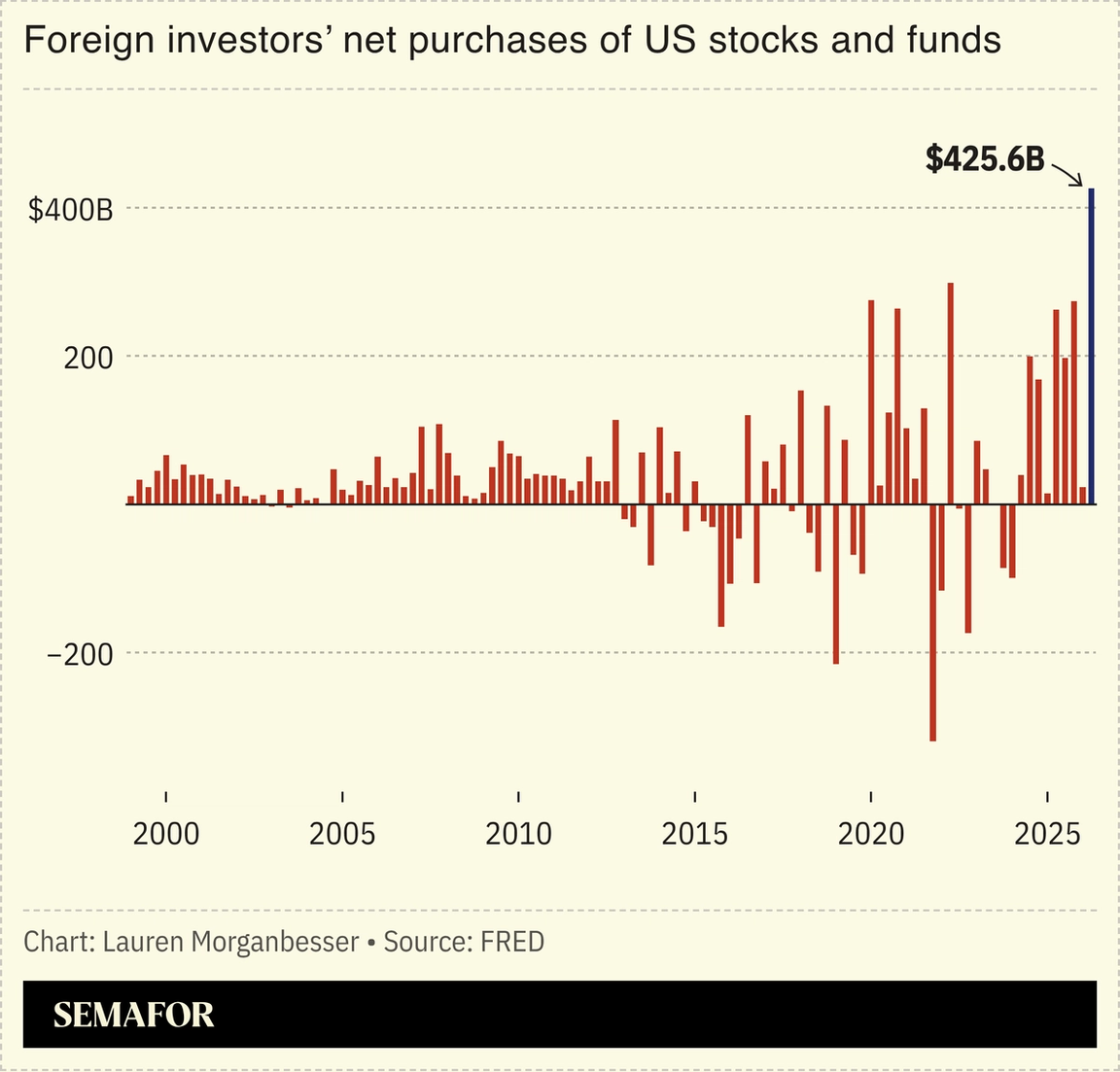 Net purchases of US equities and investment fund shares by foreign investors reached a record $426 billion in the second quarter, as overseas capital piled into an AI boom that has shown few signs of slowing. Hundreds of billions of dollars have moved in and out of AI-exposed stocks, with semiconductor firms showing dramatic swings amid mounting warnings of the technology’s risks: “This has been a narrative market, and the narrative changes every other week,” an investment manager told Bloomberg. Still, it “feels like the world is very high on US equity,” a Council on Foreign Relations expert said. Multinationals are now gauging countries’ “AI openness” when deciding investments, the Financial Times reported, putting Europe at a potential disadvantage to the US. |
|
Governments fall behind in AI debate |
 Brendan McDermid/Reuters Brendan McDermid/ReutersProgress in frontier AI development is far outpacing governments’ capabilities — and willingness — to police it. “There is a disconnect between the law and the reality of what is being regulated,” one former EU official said, pointing to the bloc’s 2024 AI Act; once touted as the first comprehensive AI legislation, the law has been overtaken by technological developments, becoming a “cautionary tale,” The New York Times wrote. Though US President Donald Trump has opposed regulation, “it’s probably going to happen anyway,” Transformer wrote. Google, OpenAI, and Anthropic are coordinating on their own “Standards Authority for Frontier AI,” The Information reported, as the latter two firms probe “tens of thousands” of security incidents linked to their models, according to Axios. |
|
US, China eye further talks after summit |
 Kylie Cooper/Reuters Kylie Cooper/ReutersUS President Donald Trump and Xi Jinping will meet twice more in 2026, setting up further bilateral discussions after the Chinese leader’s much-touted trip to Washington yielded little substance. Reflecting unprecedented ceremony for a Chinese leader in the US but producing no major policy concessions, last week’s summit was a “historic validation of China’s strength,” a former Obama adviser told The New York Times. While the US and China agreed to maintain tariff levels, the “short extension of the trade armistice only underscores its fragility,” Semafor’s China columnist Andy Browne argued, as Beijing continues to squeeze rare earths supplies to the US and its allies. Washington may put store in future talks, but that remains “a diplomatic hope, not a deliverable,” Browne wrote. |
|
US-Iran talks continue as tensions rise |
 Nathan Howard/Reuters Nathan Howard/ReutersThe US and Iran signaled a willingness to continue negotiating this week, even as the two sides appeared no closer to closing the stark gap between them. US President Donald Trump said Saturday he rejected Iran’s proposal to reopen the Strait of Hormuz, yet told Axios he expects “more talks.” Tehran’s foreign minister struck a similar tone, saying Iran is “fully prepared” to resume fighting while insisting it remains ready for diplomacy. But escalation risks continue to grow: Pakistan’s and Turkey’s military chiefs headed to Saudi Arabia while weighing intervention against the Houthis on Riyadh’s behalf, as UK investigators probed Tehran’s possible involvement in an attempted bomb plot Sunday against an air base used by Washington in its war against Iran. |
|
Oct. 7 reports heap pressure on Netanyahu |
 Eduardo Munoz/Reuters Eduardo Munoz/ReutersSeveral new reports alleged that Israeli Prime Minister Benjamin Netanyahu failed to relay advance warning of Hamas’ Oct. 7 attacks to Israel’s security chiefs, shedding new light on a question that’s dominated the country’s pivotal election campaign. Five former senior Israeli security officials who spoke to The New York Times said Netanyahu failed to mention the UAE’s explicit warning of Hamas’ attack plans, previously reported by the Israeli newspaper Haaretz, when they spoke days before the attacks. Separately, The Atlantic reported that Egypt’s intelligence chief personally traveled to Israel to deliver a warning. Facing a tight reelection campaign, Netanyahu has “scapegoated his former intelligence chiefs and military leaders” for failing to prevent the attacks, SpyTalk News wrote. “Apparently, they’ve had enough.” |
|
US troops join Ecuador’s drug war |
 Cristina Vega/Reuters Cristina Vega/ReutersAmerican military personnel joined Ecuador’s security forces in raids and arrests around the country targeting alleged drug traffickers, as the Trump administration steps up its hands-on involvement in fighting Latin America’s criminal groups. Vowing “unmatched military might” in the Western Hemisphere, US President Donald Trump has pursued closer security ties with right-wing governments and escalated military strikes on alleged drug-trafficking boats. Trump’s approach is reshaping the role of the US military in a fight long led by Latin American security forces. “What we are seeing in Ecuador is unlike anything we’ve seen even during the Cold War,” a security expert told The Wall Street Journal, adding it could signal US troops getting “very close to or participating in combat.” |
|
Swiss vote down neutrality measures |
 Stefan Wermuth/Reuters Stefan Wermuth/ReutersSwiss voters on Sunday decisively rejected stricter neutrality rules that would have prevented the country from sanctioning Russia and curbed its cooperation with NATO, delivering a boost to the alliance’s efforts to counter Moscow. Publicly endorsed by the Kremlin, the far-right-backed constitutional proposal was expected to fail, but the 70-30% result was greater than pollsters predicted — a blow to Russia, which is betting on an EU that is, if not friendlier to Moscow, “hamstrung by discord,” a Carnegie Endowment expert wrote. In November, Swiss voters will decide whether the country should be allowed to export weapons to allied countries involved in armed conflict, a change that could bolster Swiss ties with other European nations and boost its defense manufacturers. |
|
 Will you feel “relief or regret?” That’s the question Motorola Solutions Chairman and CEO Greg Brown asks himself about every consequential decision. On this week’s episode of The CEO Signal, presented by PwC, Brown explains how nearly two decades of activist pressure, private-equity involvement, and asking “dumb questions” have shaped the way he leads the public safety technology company. Brown reveals the moments when he challenged his board to fire him if they disagreed with his conviction, and other times when he decided to “check [my] ego at the door.” In a candid profile of leadership under pressure, Brown tells Andrew and Penny when he nearly quit, how to put your best people on your biggest problems, and why he thinks his most challenging investors made him a better CEO. Watch the latest episode of The CEO Signal now. |
|
Panama urged to reopen copper mine |
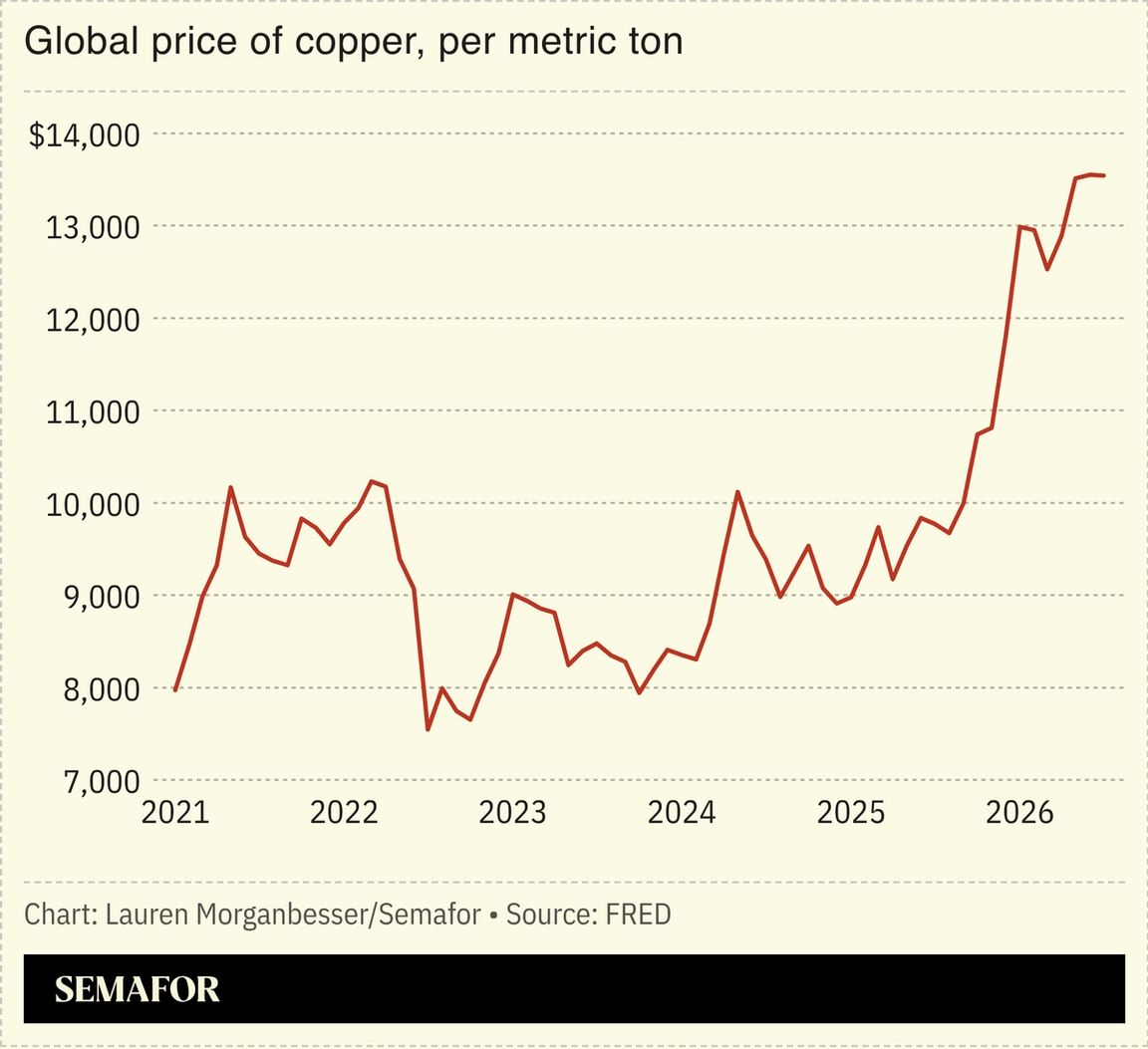 With copper prices soaring to record highs, Panama can no longer afford to keep a mine that used to produce 1.5% of global supply shut, a prominent analyst argued. Before Panama City shut First Quantum Minerals’ Cobre Panamá project for environmental reasons in 2023, the open-pit mine produced around 5% of the country’s GDP, a significant figure given how reliant Panama is on the canal. The mine has taken on renewed importance globally as a copper supply shortfall — which Morgan Stanley says is the biggest in at least two decades — pushes authorities in the Central American nation to reconsider the closure. “The economics are simply too compelling to ignore,” Juan Pablo Spinetto wrote in Bloomberg. |
|
Online scam centers expand footprint |
 Cambodia’s Prime Minister Hun Manet at an international conference on combating online scams. Soveit Yarn/Reuters Cambodia’s Prime Minister Hun Manet at an international conference on combating online scams. Soveit Yarn/ReutersAuthorities in Papua New Guinea rescued 39 Indonesians from a compound housing an online scam operation, suggesting transnational cyberfraud groups are spreading out from traditional Southeast Asian hubs. Four Chinese nationals were detained in the suspected human-trafficking effort, a police official told the Organized Crime and Corruption Reporting Project. The crackdown is the latest example — alongside East Timor, Madagascar, and Sri Lanka — where authorities have found online scam centers, a significant geographic widening of a multibillion-dollar industry in which trafficked victims are coerced into defrauding unsuspecting people online. It had been concentrated in Cambodia, Laos, and Myanmar, but Phnom Penh last week held a global conference on combating cyberfraud, pledging that it would “never be a safe haven.” |
|
|


