Lambda Cloud Newsletter: September 2026
Lambda Monthly newsletter
Lambda cloud newsletter header

This month: Stephen Balaban, Lambda's co-founder and chief technology officer (CTO), told Founders in Arms how five pivots in 14 years added up to Lambda. We joined the NVIDIA Open Agent Safety Platform announcement and helped SPREEAI increase its GPU utilization from ~20% to 43%.

On NVIDIA HGX B200 systems, NVIDIA DSX MaxLPS let us run 19 nodes on the power budget of 16. In MLPerf Inference v6.1, software alone added 8.85% throughput on the same GPUs, and a single run delivered two firsts.

Plus: StereoPolicy, a robot-learning method from Stanford, Northwestern, and Lambda, gives robots 3D vision from stereo image pairs alone.

OpenResearcher's 30B open model beat GPT-4.1, Claude Opus 4, and DeepSeek-R1 on BrowseComp-Plus; and Lambda's chief commercial officer (CCO), Robert Brooks IV, asked enterprise AI leaders how they decide what to build and what to buy.
Spotlight /

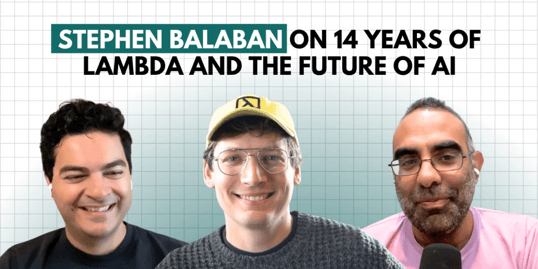
Stephen Balaban on 14 years of Lambda and the future of AI

Stephen Balaban on five pivots in 14 years

Stephen Balaban, co-founder and CTO, has been through five pivots in 14 years. He started with facial recognition and AI filters before building the workstation and GPU compute business. In this Founders in Arms podcast interview, he walks through the long, non-linear path behind Lambda and the decisions that shaped it along the way.

Listen to the podcast
Lambda joins the NVIDIA Open Agent Safety Platform announcement

Lambda joins the NVIDIA Open Agent Safety Platform announcement

The organizations developing AI have the deepest understanding of their technology, and we’re pleased to support companies such as NVIDIA that are taking a leadership position to facilitate responsible use and development. The NVIDIA Open Agent Safety Platform is a concrete step toward setting safer boundaries for AI agents, enabling teams across industries to run frontier training and inference safely.

Read more
Line illustration of a person in a button-up shirt with two chest pockets, outlined in offset red, green, and blue, set inside a phone screen.

How SPREEAI doubled GPU utilization

Online shopping has a ~$45B fitting-room problem, and SPREEAI is building photorealistic virtual try-on to solve it. One pass solves pose, cloth physics, identity, and texture, and it runs at the limit of the GPU's memory. Before the rebuild: 96 GPUs reserved, utilization around 20%, storage at 2.7 PB. Working with Lambda's machine learning (ML) engineering team, SPREEAI restructured orchestration and data sharding, pushing utilization to 43%.

Watch the video

Hot off the command line /

Lambda maximizes performance per watt with NVIDIA DSX MaxLPS

Lambda maximizes performance per watt with NVIDIA DSX MaxLPS

Power is becoming a major constraint on AI infrastructure. In a proof of concept on NVIDIA HGX B200 systems, we fit 19 nodes into the power budget of 16 with NVIDIA DSX MaxLPS, observing ~24% more token throughput and ~23% higher performance per watt.

Read more
MLPerf Inference v6.1: same GPUs, 8.85% more throughput

MLPerf Inference v6.1: same GPUs, 8.85% more throughput

Same NVIDIA Blackwell Ultra GPUs as v6.0, 8.85% more GPT-OSS 120B throughput, all from software. We also ran MLPerf's first agentic workload on data center hardware, using Kimi K2.6, the first model over a trillion parameters deployed in MLPerf.

Read more

Knowledge drop /

Giving robots 3D vision without depth sensors

Giving robots 3D vision without depth sensors

StereoPolicy gives robots 3D perception without depth sensors, depth maps, point clouds, or LiDAR. It learns 3D structure directly from stereo image pairs. Across five real-world tabletop tasks, it hit 59% success vs. 42% for RGB, 41% for RGB-D, and 14% for PointNet. Built by Stanford, Northwestern, and Lambda.

Read more
OpenResearcher: training research agents at scale

OpenResearcher: training research agents at scale

A 30B open model trained entirely on offline research trajectories beat GPT-4.1, Claude Opus 4, and DeepSeek-R1 on BrowseComp-Plus. OpenResearcher scored 54.8%, up 34 points from its base model. It also transferred to the live web without live-web training data. The work comes from Texas A&M, Waterloo, UC San Diego, Verdent AI, NetMind AI, and Lambda, and was accepted to EMNLP 2026.

Read more