
|
 |
Trump’s Corruption Is Different In Kind
He isn’t just more corrupt than most politicians; corruption is his raison d’être. This isn’t just “government corruption” to be reformed away. It’s a GOP crime spree, and voters need to know it.
|

| |||||||||||||||


 |
Donald Trump may no longer be able to outrun his reputation as a crook and a thief.
 |
That might ring discordant to keen readers, who know that corruption has defined Trump’s entire life, to say nothing of his life in politics. But one of the most infuriating facts about the Trump era is that, for much of the past decade, he’s managed to neutralize corruption as a political liability. There’s truth and there’s what you can prove in the court of public opinion. While as a factual matter, Trump is far and away the most corrupt political figure in the history of the country—the people who believe Trump is dangerously corrupt have been well grounded in their belief—the general public has been split on the question of which of the country’s major political parties is more corrupt.
Indeed, voters frequently identify the Democratic Party as the more corrupt of the two. Trump loyalists won’t admit Trump is corrupt, or any more corrupt than a typical politician; Republican lifers won’t accept their party’s complicity. But they are all happy to believe or claim that the Democratic Party and its leadership are shot through with fraud.
This is simultaneously a triumph of propaganda and an artifact of institutional failure. Republicans built echo chambers designed to deliver received wisdom to a huge swath of the country, and they know corruption is a political liability. They’ve thus spent the entire decade assassinating the character of prominent Democrats, leveling false or exaggerated accusations of fraud and criminality against all factions of liberal society, while ignoring or denying Trump’s relentless crime spree.
This effort was easier than it should have been, though, because most Democratic leaders and the leaders of liberal institutions convinced themselves most citizens did not care about political corruption—at least, not unless it came back to bite at the kitchen table. They decided the antidote to Trump’s bombast was boring, normal politics. In their schema, partisan conflict commensurate with Trump’s abuses was both unnecessary and unwise. It wouldn’t persuade independent voters and would force marginal members to get crosswise with their right-leaning constituents.
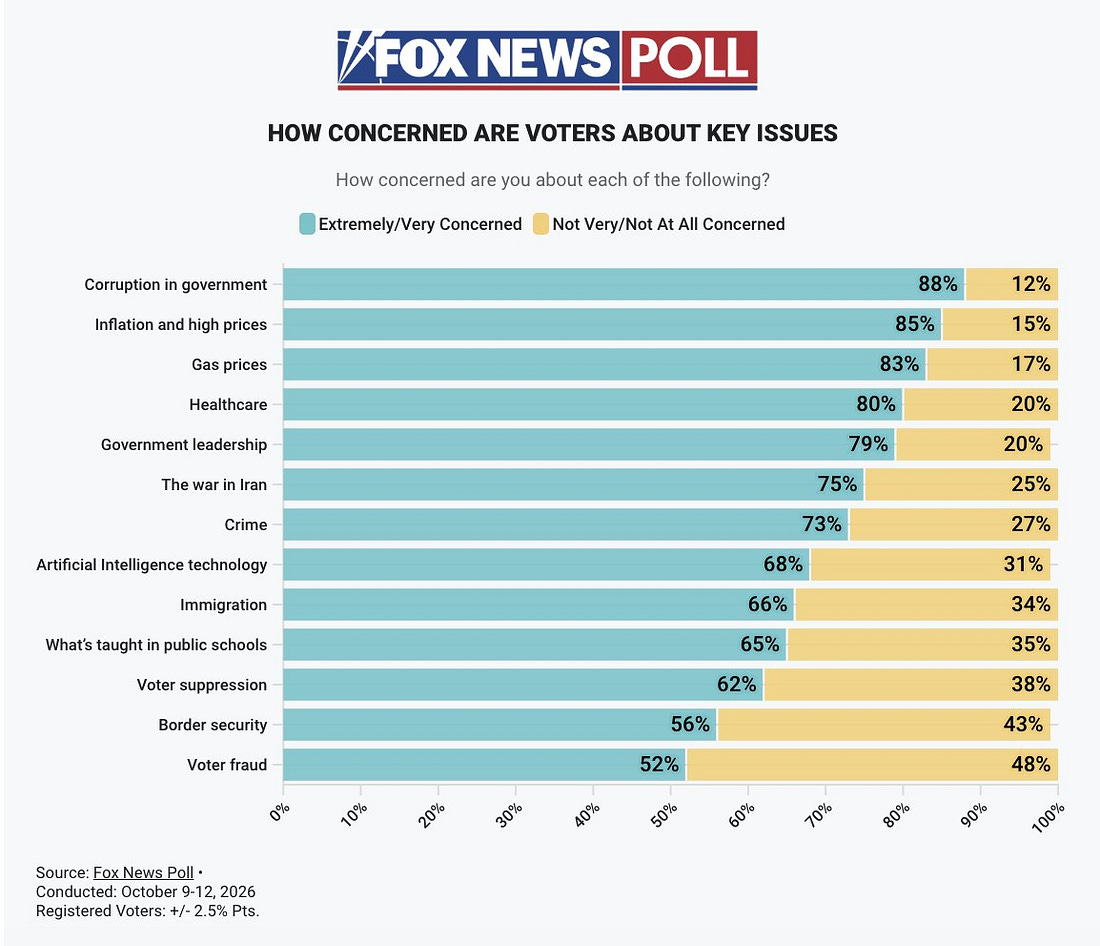
As the graphic above suggests, though, the information imbalance driving public misperception is starting to disappear. The poll itself doesn’t ask the polarizing question, which party is more corrupt. But if you dive into the crosstabs, you’ll see that concern about corruption in government is too lopsided for Republicans to be fighting the question to a draw any longer. Even if every Republican respondent claimed to be concerned exclusively with Democratic corruption, the results would still suggest that Trump’s corruption has “broken through” to, and alarmed, the median voter.
This is mostly a bed Trump made for himself. His first term corruption was historic. His second term corruption is much more extreme, and more salient.
And so while the right-wing propaganda apparatus continues to whir, and many of the mainstream political media’s most entrenched pathologies remain unaddressed, truth has fared better.
Investigative reporters deserve a lot of credit. They have unearthed conscience-shocking scandals. Just this week the Washington Post reporters obtained the full list of donors to Trump’s ballroom project. They detail how, after bulldozing the east wing of the White House, Trump financed his plans to build himself a palace ballroom with pay-to-play bribes from grifters, corporate elites, and people seeking pardons. That was Thursday. On Tuesday, Bloomberg exposed a brazen attempt by Trump appointees to kill an investigation of hundreds of millions of dollars worth of insider trades, which were timed to front-run Trump’s March announcement that he would not annihilate Iran’s civilian infrastructure.
Go back through the weekly archives, and they all kind of look like this.
But Trump has also entangled himself with huge, predatory industries with mass customer bases. Crypto, betting markets, A.I. This disintermediates his corruption. People no longer need to learn that Trump is lining his pockets by creating bribery funnels for a small elite. Industry leaders know his corruption because they are either enmeshed in or a target of it. Consumers know it, because they can see and feel the effects downstream, when their Trump coin goes bust, or data center construction begins down the road.
This dawn of consciousness is an important predicate to imposing meaningful anticorruption reforms, as a pillar of post-Trump reconstruction.
But it is still not enough. We can see now that “corruption in government” is the public’s top concern. What we need, additionally, is mass consensus that the unfolding corruption crisis is a GOP brainchild. Trump’s vision, which loyalists in his party abetted and allowed to thrive. “The system” may be corrupt, or corruptible, but today’s corruption is not systemic. It is partisan. It is Republican.
This consensus remains elusive in large part because many liberal elites still behave as though acute public backlash to government corruption is entirely an outgrowth of economic malaise—referred pain from things like high gas and diesel prices. We need Democrats to catch up with their own voters and treat Republican corruption as an affront in and of itself. Expose it, whatever its shape, and pursue the culprits. Because laws alone mean nothing to a party of criminals. If reforms arenR