




October Surprise: 30% OFF Bulwark+ for a year. Upgrade now. |
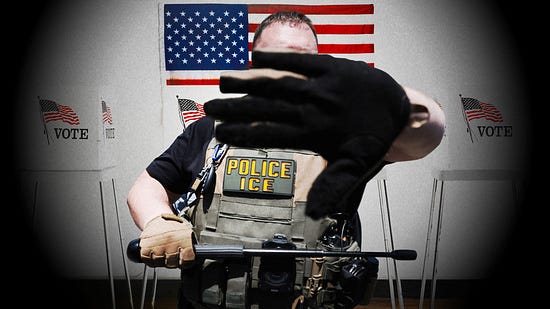 |
PRESIDENT TRUMP IS ALREADY laying the predicate for interfering with the polls this November, from rhetorical and regulatory attacks on voting by mail to frenetic searches by his administration for non-citizens on state voter rolls, most recently in Nevada and California. One of the most threatening possibilities is that the Department of Homeland Security will deploy ICE or other armed agents to polling locations. The Trump administration denies planning such a move, but that hasn’t stopped opposition groups from gaming out scenarios and making contingency plans.
In late May, staff from the offices of Democratic state attorneys general and secretaries of state gathered in Milwaukee to wargame the threat of federal intrusion in state elections, including ICE agents showing up at the polls, according to one attendee.
Then in August, Hillary Clinton invited three dozen legal experts, elected officials, labor leaders, and cable news figures to Washington, D.C. to think through possible electoral chicanery by the administration and develop methods to ensure election integrity.
Beyond these tabletop exercises, pro-democracy activists have organized massive projects to train thousands of “democracy protectors” to observe polling places. In mid-September, state Democratic parties announced the New Battlefield Project to recruit and train poll watchers. Likewise, Vote Safe, a campaign by veteran civil rights and advocacy organizations, is working to deploy hundreds of observers to heavily Latino and black counties in states with competitive Senate races.
The purpose of the exercises is to build connections between lawyers and groups on the ground—including some that didn’t exist two years ago.
Upgrade Today at 30% OFF & |

STEPHEN RICHER ATTENDED THE SIMULATIONS in Milwaukee in May. As a Republican who served as the top election official in Maricopa County, Arizona’s most populous county and the site of razor-thin election margins seemingly every cycle, Richer received death threats for upholding the 2020 election results. “One of the reasons I’m invited is I know how elections are administered,” he told me.
He said participants in the wargame sessions regularly consider the possibility of ICE arriving at the polls within the first hour. Some possible responses Richer has seen include asking the courts for an injunction to remove ICE from the voting location, establishing a hotline to report sightings, and stationing observers at the polls.
Richer offered a note of reassurance. “I don’t mean to discount the very real anxiety that this could produce for voters, and arguably already has for voters, but logistically, ICE blanketing the states is far-fetched,” he said.
States would potentially have legal recourse after ICE-induced voting disruption. Richer notes that non-malicious election day occurrences, such as losing power, have led to district court orders to keep a voting location open past its scheduled closing time. Interference, he said, like Trump posting a targeted threat online or violence near a voting location, would likely result in the polls staying open longer.