
|
Oct 17, 2026
|
|
|
|
|
Supported by
|

|
|
|
|
|
| Welcome, Weekenders! |
| A song has been stuck on loop in my mind for days now. Yeah, this one. |
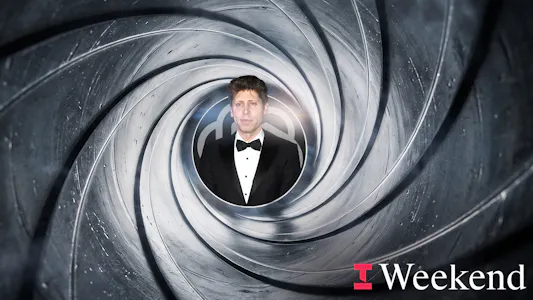
| C’mon, haven’t you heard the big, brassy James Bond theme playing too? We have an honest-to-goodness spy scandal on our hands! That would be the affair over at OpenAI, where the FBI has arrested a former engineer, Abdulrahman Alfozan, for allegedly placing a toilet paper–wrapped recording device in a conference room. Why’d he do it? The Justice Department wasn’t explicit in its press release announcing Alfozan’s arrest, though the statement does make sure to prominently describe him as a “national of the Kingdom of Saudi Arabia,” implying, obviously, that he was hoping to spy on OpenAI for the Saudis. |
| I expect a not unsizable part of Silicon Valley experienced some schadenfreude when reading about the turn of events at OpenAI. I’d advise against indulging in that feeling, because when I struck up conversations with a few corporate security consultants and surveillance experts over the last few days, they all echoed the same sentiment: Plenty of companies risk ending up in the same situation—especially as they move quickly in today’s era of frenzied, heightened competition. A discomforting thought, eh? |
| “Organizations can sometimes be moving so fast that they often don’t understand that there’s an issue associated with somebody until that person’s on board and up to no good,” said Bill Priestap, a former head of FBI counterintelligence who now runs his own security consultancy, Trenchcoat Advisors. “Meaning they’re recruiting, and they’re under such pressure to get the right people and get them on board that in many regards, they end up with a minimal understanding of the people they’re bringing on board.” Well, good thing there hasn’t been an enormous, frantic hiring binge lately. Ha ha ha. |
| If you’re starting to feel a little paranoid, I strongly, strongly advise against talking to someone like David Abbott, a San Francisco private detective, to find out how easy it is to bug an office. Such conversations will only further unnerve you—you might end up holding your next board meeting in your home basement, Tony Soprano style—because according to Abbott, it’s pretty darn easy to install a recording device. |
| A suitable one can be bought for less than $100. Some of the popular ones resemble phone chargers, which get tucked into a power socket, hidden in plain sight. He’s also seen surveillance devices in fake coffee cups—you know, like the ones that might lie casually around an office—and quite a few in fake smoke alarms. |
| More bad news: Should you find such a device, it’s like spotting an ant in your kitchen. One ant suggests the presence of more ants. “If I’m doing a bug sweep, just because I find one does not mean there isn’t a second,” said Abbott. “If you find one, there’s going to be two. If you find two, there’s going to be three. You just keep looking.” |
| What happened at OpenAI underscores Abbott’s warning. There, Alfozan, the alleged spy, did plant two bugs. Well, he tried to do so. Alfozan, not the sort who seems like he would’ve ever earned double 0 status, had placed another bug in a bag that he then mislaid: He reported it missing and had to go pick it up from the company’s lost and found. |
| OK, if I’ve spooked the heck out of you, I guess I can offer some solace by pointing you in the direction of Eric and Greg Levesque, whose Salt Lake City–based startup, Strider Technologies, has raised $110 million in the last few years to sell AI-powered software to businesses that monitors email and other internal communications, flagging suspicious behavior and possible espionage attempts. (Yes, the company’s name is a reference to Strider from “The Lord of the Rings,” the nom de cloak of Aragorn, the character Viggo Mortensen plays.) |
| “What we’ve found is that companies are not always dealing with trained intelligence operatives. Like, they’re dealing with scientists or legitimate engineers who have been approached or coerced in some form or fashion and are now working on behalf of someone else,” said Greg Levesque. “They can leave a lot of digital exhaust.”—Abram Brown (abe@theinformation.com) |
| |
|
 |
|
 |
|
 |
|
 |
|
|
|
 |
| Listening: “Reaching Out” |
| As the pandemic shut down the world in 2020, Sayre Quevedo, then a producer for The New York Times’ “The Daily” podcast, quit his job and headed out to Los Angeles, hoping for a chance at self-reinvention. To cope with those tumultuous times, he decided to pursue a documentary project, recording every phone call. Had nothing else of import happened in his life, Quevedo might’ve wound up with an intriguing time capsule. But something quite unusual did occur: Just months after moving to LA, he and his twin brother, Connor, happened to finally locate their biological father, whom they’d never before met. He worked as a barber—blocks from where Sayre lived. “Reaching Out,” a new podcast co-produced by NPR station KCRW that won a top prize in the Tribeca Festival’s expanded podcast categories, is a starkly intimate account of their journey to meet him and their reconciliation with each other, their lives and what life might’ve been like if their father hadn’t been a total stranger who happened to be just down the street.—Abram Brown |
| Reading: “Sitcom” by Chuck Lorre and “Emperor of Nothing” by Blake J. Harris |
| Chuck Lorre, the indefatigable TV showrunner, writer and producer, has kept the masses laughing for years—and years—and years, with a list of hits that includes “Two and a Half Men,” “The Big Bang Theory” and “Dharma and Greg.” Those are sitcoms, a term Lorre acknowledges once made him practically break out in hives, since it was often used to cheapen what he sees as grueling, high-touch art. With spicy good humor, he reclaims the word in his new memoir about his time in Hollywood, “Sitcom.” |
| “The truth is, making a live studio audience laugh for twenty-odd minutes every week, for twenty-two weeks, is incredibly hard and unbelievably stressful,” Lorre writes. “If you’re one of those people who insist on labeling all sitcoms as being cheap, juvenile and unsophisticated, well…all I can say is, blow me.” |
| I’d say “Sitcom” functions as a good primer on managing talent, too, and Lorre attests to having learned the importance of keeping out of the way. “Creativity needs air to breathe,” he writes. To do the opposite risks turning a leader into “one of those plastic bags you get at the dry cleaners that can kill small children.” Lorre also takes the opportunity to set down what he sees as good comedy’s basic tenets and decry the medium’s basest impulse: to write only about stupid people doing stupid things: “A better, perhaps deeper means to achieving laughter involves pain and suffering.” |
| Such a sentiment is most certainly shared by Larry David of “Seinfeld” and “Curb Your Enthusiasm,” the subject of “Emperor of Nothing,” a biography that won his reluctant cooperation. (When author Blake J. Harris finally wore David down, Harris received a two-line email from him: “Oh Jesus. If we must.”) As with “Sitcom,” “Emperor of Nothing” charts a remarkable rise across Hollywood from an inauspicious start: Lorre was a wannabe musician before his TV run, while David was a little-known stand-up comic with an unremarkable series of TV writing jobs before co-creating “Seinfeld.” |
| Like Lorre, David describes the process of penning comedy as an arduous affair. And by David’s own telling, the process of sitting down to write a new “Seinfeld” season would bring on full panic. “That always seemed like a daunting prospect,” he recalled. “Especially because all the good ideas were used up the year before.” Fortunately, David had his friendship with the show’s eponymous star, Jerry Seinfeld, one of many people within David’s orbit who gave interviews for “Emperor of Nothing.” “I would always say, ‘All we have to do is write today,’” Seinfeld said. Or as David recalled: “Jerry always talked me off the ledge.”—A.B. |
| Watching: “War” |
| No one does a charming, self-involved cad better than Dominic West, the British character actor who first washed ashore in America as “The Wire”’s Detective McNulty and then again in Showtime’s “The Affair” and in the final two seasons of “The Crown” as Prince Charles. In “War,” HBO’s new high-tension legal drama, he’s tech billionaire Morgan Henderson, a fellow championing a safer, more responsible social media—while embroiled in an increasingly messy divorce from his Hollywood star wife, Carla (Sienna Miller). Much of that mess is Morgan’s own doing: He looks wonderful in his Savile Row trousers—he just has trouble keeping them on. As Morgan and Carla gird for an extended battle, they assemble a posse of cutthroat attorneys, who find their impulsive clients constantly upending their carefully laid strategies. That flock of legal eagles includes a handsome rogue, Johnny (Archie Renaux), a lad from working-class south London who sees a chance to ascend by, uh, redefining zealous representation. Backstabbing and double crosses abound.—A.B. |
|
|
|





 Gift Subscription