
|
 |


Desperate to avoid an embarrassing loss in the midterms, Trump is still trying to find a way to use his false claims about “illegal immigrants” voting to interfere with mail-in voting, even after the Supreme Court told him no. We’ve discussed his debacle in Nevada, where he claimed that nearly 16,000 people on the voter rolls weren’t citizens. The New York Times headline captured the outcome of that one perfectly: From 16,000 to 185 to Zero: Trump’s Claims of Illegal Voting in Nevada Fizzle. After the administration downgraded its estimate from 16,000 noncitizen voters to 185, Nevada’s Attorney General’s office responded that as to all of them, “our records indicate that they were citizens.” But, undeterred, Trump tried again in California last week.
California counties began mailing ballots to registered voters on October 5, ahead of the elections. They could be voted and returned as soon as they were received. But on October 13, 2026, just three weeks before Election Day and after voting was well underway in the state, the Department of Justice sent letters to California Secretary of State Shirley Weber and Los Angeles County Registrar-Recorder/County Clerk Dean Logan, giving them until noon on October 15 to review a list of purported “likely noncitizens who were sent a vote-by-mail ballot from California to participate in the November 2026 federal election.”
The letters directed the California officials to do two things:
(1) “segregate” already-returned ballots from listed voters whose citizenship couldn’t be “immediately” verified as citizens, and
(2) refrain from sending ballots to people on the list “until we [the Trump administration] confirm their citizenship status.”
The letter also directs California officials that “If a ballot for any individual on the list has been returned, instruct the appropriate elections official to not verify the signature and/or tabulate the ballot until citizenship can be determined.”
Three. Weeks. Before. Election. Day.
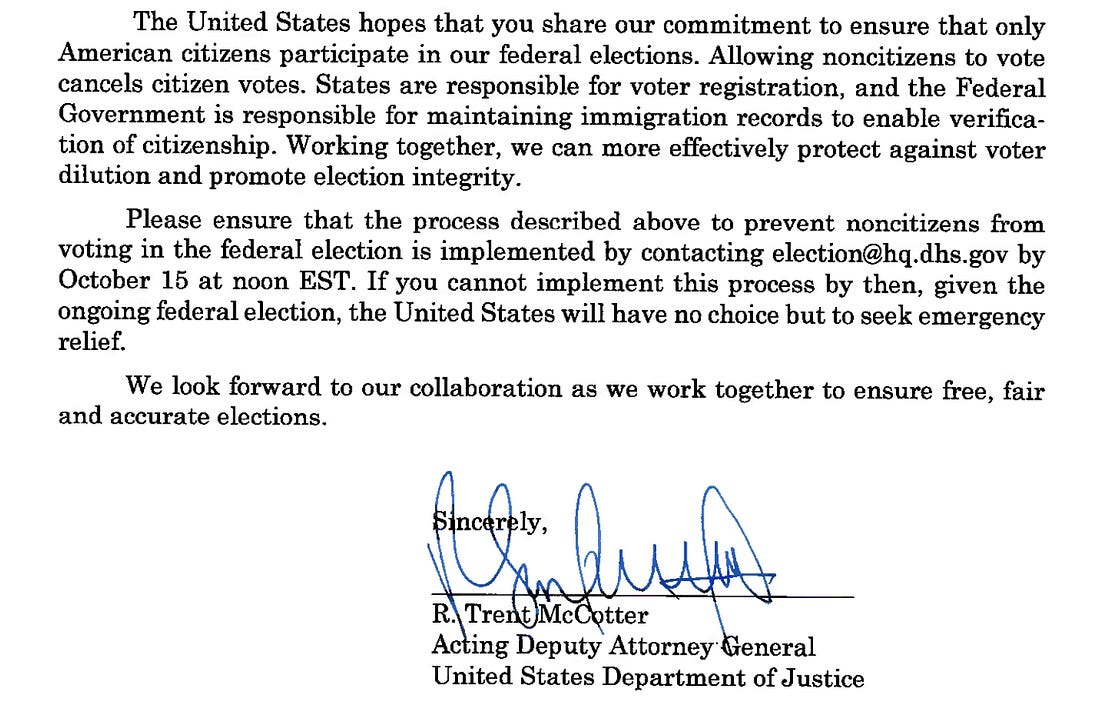
The letters concluded with a threat: If election officials “cannot implement this process [within 48 hours], given the ongoing federal election, the United States will have no choice but to seek emergency relief.” Honestly, on these facts, a lawsuit by the government doesn’t seem destined for success. And that may be the point here.
California officials declined to participate in the Trump administration’s ridiculous scheme. Secretary Weber noted that the November general election was less than three weeks away, and pointed out that the government’s demand violated a court order in Common Cause v. U.S. Department of Justice. That case challenged the Trump administration’s effort to create a nationwide database of registered voters and use it to identify people DOJ wanted to see removed from state voter rolls. But Judge Sparkle Sooknanan in Washington, D.C., put an end to DOJ and DHS efforts to compare state voter roll information “against a federal database to identify purportedly ineligible voters” and use that to process to demand states remove voters from the rolls, because it could keep eligible citizens from voting. California believes DOJ’s new request would violate that order.
DOJ responded to California’s refusal by suing them last Thursday.
This is about voter suppression, not protecting elections. As the New York Times recently reported, the actual data shows that “While President Trump has claimed that noncitizens voted en masse and even tipped the scales in recent elections, research from partisan and nonpartisan groups alike has shown that instances of noncitizen voting are so rare that they have never been significant enough to change the outcome of an election.” On the other side of the equation are thousands of eligible citizens whose ballots could be discounted if the government, so late in the process, throws ballots into question with little if any basis for doing so. The administration is doing everything it can to suppress eligible voters, including issuing a threat that “local officials who process and tabulate ballots submitted by suspected noncitizen voters are putting themselves at risk of criminal investigation and potential prosecution.”
Marc Elias is already seeking to intervene in DOJ’s lawsuit against California, filing on behalf of two nonprofit organizations, Services, Immigrant Rights and Education Network (SIREN) and Mi Familia en Acción. California Attorney General Rob Bonta is a capable litigator in his own right. The government could seek an injunction this week to try and force California into compliance with its demands. But so close to the election, it’s hard to imagine the legal basis for doing so; in fact, DOJ doesn’t argue that one exists in its letters to California, simply making the demand and baldly claiming “this process will protect American citizens' votes while preventing noncitizens from participating in the federal election in violation of federal law.”
 |
If the government really believed there was a problem, it could have started working with the states on this a year ago. It could have filed its lawsuit 10 months or 18 months before the election. Instead, it chose the three-week mark, well inside the 90-day period the Motor Voter Act (the National Voter Registration Act, or “NVRA”) established ahead of elections, barring systematic programs to remove voters from the rolls. As Elias notes in his request to intervene, the law established that period “because that is when mistakes based on flawed data are most likely to disenfranchise eligible voters.” Having failed to act sufficiently in advance of the election, the government is free to take this up afterward and see if it can make out a case—it certainly doesn’t look like it has the evidence to do so, but it’s free to try. But what it shouldn’t be permitted to do is tell voters their ballots can’t be counted on the basis of DOJ and DHS’s suspicions, especially given the administration’s track record in Nevada and elsewhere.
And that seems pretty obvious. Trump’s lawyers may take morally reprehensible positions, but they are not stupid and they cannot fail to see this. As Elias notes in his motion, “the Trump administration’s own estimate has already fallen from more than 190,000 in July to roughly 20,000 today. The DOJ has not produced any underlying data or answered questions about how the list was generated.” Trump’s lawyers have to be anticipating a loss. So is the California scheme something Trump demanded that they do? It seems like an awfully specific plan for him to come up with.
It seems far more likely that what’s happening here is that the administration is setting up a narrative for after the election about how it was stolen. What if the whole goal here is to have the courts slap down the case, so that Trump can argue, after a potentially devastating loss for Republicans at the polls, that it happened because the courts refused to stop noncitizens from voting even though he begged them to? It wouldn’t be true, but when has that ever stopped this president? That kind of pernicious narrative fits with the guy who perpetrated January 6 and who has never felt compelled to stick to the confines of the truth when talking about election outcomes.
That’s what we need to be on guard for here. Trump is already laying the groundwork to claim another election was stolen, rather than accept a result he doesn’t like.
What should we all do in the face of all of this? This is the time to vote early if you can and make a plan to vote on Election Day if you must—and make sure you take as many friends as possible along with you! It’s far more difficult to challenge an election with a large margin of victory. Voter turnout is going to be the key to spoiling Trump’s plans. We know what he’s up to. Now, let’s make sure that people who care about democracy get out and vote.
If you read Civil Discourse but haven’t become a paid subscriber yet, I hope you’ll consider doing that today. At a time when it’s increasingly important to distinguish what the law actually is from what politicians claim it says, I want to keep the newsletter available to everyone, whether they can afford to pay or not. That’s why Civil Discourse doesn’t have a paywall six days a week. Paid subscriptions make that possible. If you value having a place where we can work through the facts, understand the law, and figure out what matters, I hope you’ll support it by becoming a paid subscriber.
We’re in this together,
Joyce