
|


 |
Friends,
America makes its choice two weeks from Tuesday.
It’s not really a choice between two parties. After all, a record 45 percent of American voters now call themselves “independent” and don’t align with either party. And most of us who still describe ourselves as Republicans or Democrats don’t have much love for whichever party we’re registered with.
Nor will it be a choice between the “left” and the “right,” as those terms have been used for the last half-century — representing preferences by the left for more and bigger social safety nets and by the right for lower taxes. These days, big business wants more government in the form of subsidies, bailouts, no-bid government contracts, and a giant military-technology state.
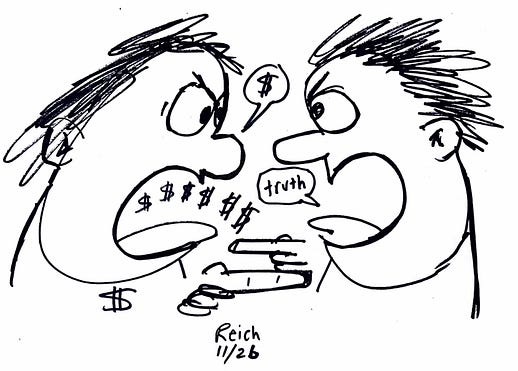
The real choice is between ever more concentrated wealth and power at the top — in the billionaire class, tech bros, Wall Street, and the C-suites of giant corporations — versus more wealth and power in what used to be the American working middle class.
That’s what the “affordability crisis” is all about. It also underlies America’s growing concern about corruption.
For the last few weeks it’s looked as if America was about to choose the second path, for The People and against Big Money.
But Big Money is now striking back. Elon Musk is pouring hundreds of millions into supporting Republican candidates, as are Big Crypto, AIPAC, AI, and Trump’s MAGA Inc. (and its related super PACs).
“Dark money” — anonymous campaign donations flowing through so-called “nonprofits,” mostly from wealthy individuals and CEOs — is also dropping into the system.
Democratic candidates are being outspent 2-to-1 by super PACs and megadonors. More than in any midterm since the Supreme Court’s shameful Citizens United decision, Big Money is going almost exclusively to the GOP. The Supreme Court has given Republicans an additional spending advantage by allowing super PACs to work in close cooperation with candidates.
Texas’s James Talarico hasn’t taken any corporate PAC money, for example, and has an army of volunteers going door to door for him and has accumulated one of the largest small-donor war chests of any candidate in this election cycle. But his opponent, Ken Paxton, is relying almost entirely on $158 million he’s got from Musk via a Republican super PAC.
This enormous gusher of Big Money for Republicans has no regulatory oversight because the Federal Election Commission has no quorum and therefore can’t function.
At the state level, Big Money is attacking ballot measures to increase taxes on the super-rich — such as California’s Proposition 40, a one-time 5 percent tax on billionaires. Google multibillionaire Sergey Brin is sinking hundreds of millions into defeating it. Gavin Newsom also opposes it. But another California presidential hopeful, Ro Khanna, is pushing for it, to his great credit. (Note to California voters: Vote YES on 40 and NO on the poison pills, Props 41 and 42.)
This election is the clearest contest yet between Big Money and The People. Spending by super PACs and other megadonors in the current midterms is over 50 percent higher than in the 2022 midterms, in inflation-adjusted dollars.
I wish I were more confident that The People will prevail. Democrats are doing well in the polls, but polling is flawed when it comes to the influence of Big Money. Many so-called “low-information” voters are more likely to be swayed by media advertising and less likely to respond to polls or tell pollsters truthfully how they intend to vote.
When this is over, if the Democrats take back the House and at least come close to retaking control of the Senate, high on their agenda must be seeking to get Big Money out of our politics — via constitutional amendment or public financing of elections (matching small-dollar donations). And also going after the source of much of the Big Money by enacting a national wealth tax.
In the meantime: stay calm, support good candidates, do whatever you can to get out the vote, and vote as soon as you can.
| ||||||||||

